Monotropic Time: A Different Rhythm
If you are Autistic, ADHD, or AuDHD, time may not feel like a straight line, and you may feel you are constantly battling against the time on the clock. Your internal perception of time may feel more like a spiral, looping, stretching, expanding and contracting, sometimes speeding up and other times slowing down. It can feel like you’re living in a different dimension from other people, not just because of neurodivergent social, sensory, and communication differences but also because you may feel and experience time itself differently. I am AuDHD and monotropic, which means I tend to focus deeply on a few things at a time. I think the theory of monotropism (Murray et al., 2005) can help to explain why I experience time differently than people who aren’t monotropic – you may or may not resonate with this – let me know!
Neuronormative Time
In her book Time Binds (2010), Elizabeth Freeman introduces the idea of “chrononormativity”. This is the way society teaches us to use our time in very specific, usually productivity focused ways. Examples of this are 9-to-5 jobs, school timetables, deadlines, and meeting expectant life stages, e.g. marriage, having children, getting a job and then retiring, all within certain time frames. I feel like time is part of the invisible rulebook that we are expected to live by.
I call this neuronormative time. Neuronormative time is the time that is set out and reinforced by the neuro-majority of people (those who aren’t neurodivergent or disabled). Neuronormative time is linear, rigid, and deeply tied into capitalism, productivity and ableism. If you’re Autistic, ADHD, or both, you might constantly be told you’re “late,” or “disorganised,”. However, it’s not that you’re broken or need any interventions or to be ‘fixed’. Instead, I am suggesting you may be on a different temporal wavelength, you may experience time differently. As Tolani and Venkatesan wrote recently in The Time We See (2025), time isn’t neutral. It’s shaped by societal expectations that often don’t work for neurodivergent people.
What Is Monotropic Time?
Monotropism is a theory that describes how some people, especially Autistic and ADHD people (Garau et al., 2023), tend to focus more of their attentional resources deeply on a few things rather than spreading it thinly across many channels. I believe that this can also impact and change how we experience time.
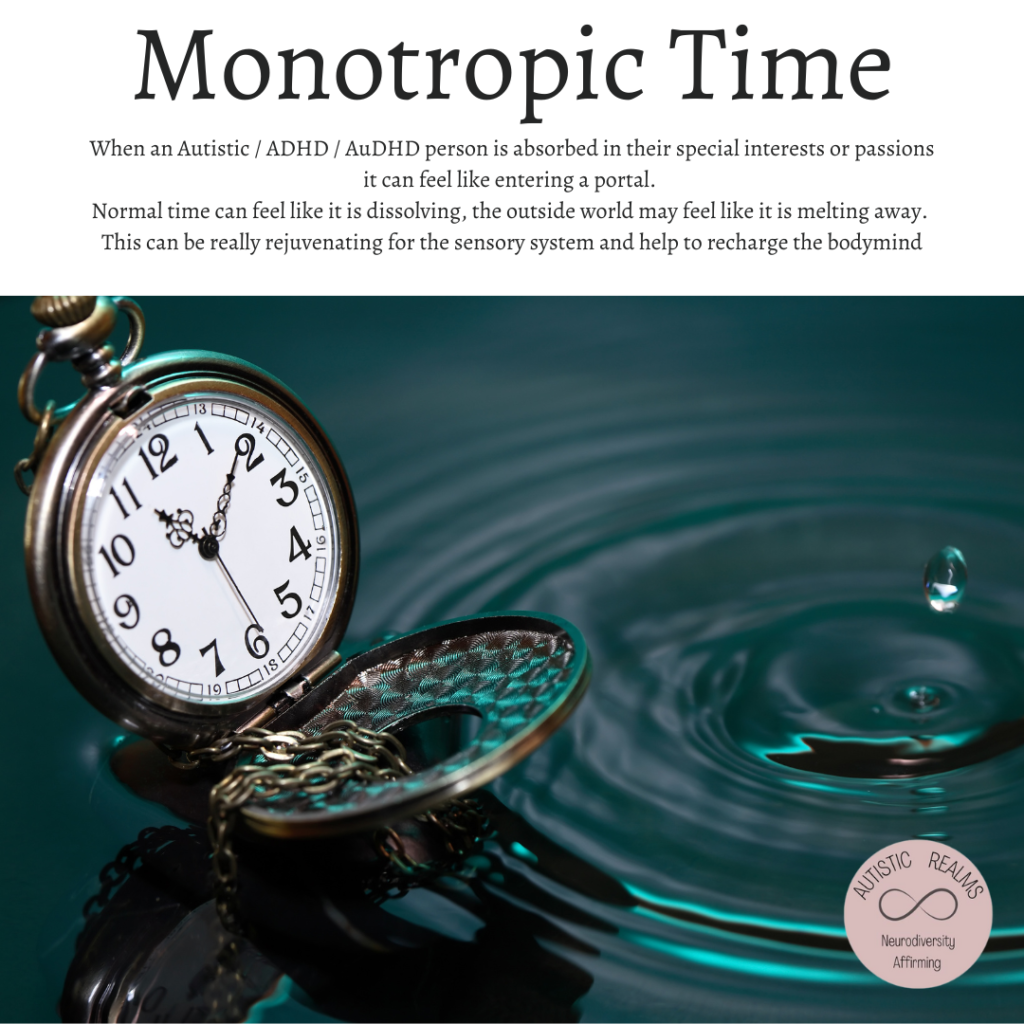
When you’re deep in a special interest, engaged in your passion, or completely absorbed in a sensory experience and deep in a flow state, it can feel like time stops existing or just seems to melt away. Minutes pass by, and without you realising it, they can quickly become hours (or the other way around if you are trying to engage in something that is not fully hooking you in). It is perhaps not that we are “losing time”, but we are “living time differently”; maybe we are experiencing monotropic time.
This might also explain some of the Double Empathy Problem, a concept developed by Damian Milton (2012). It suggests that there is a mutual misunderstanding between people with different lived experiences. This may include the differences between monotropic and polytropic people as we experience and manage time differently.
The River of Monotropic Flow States

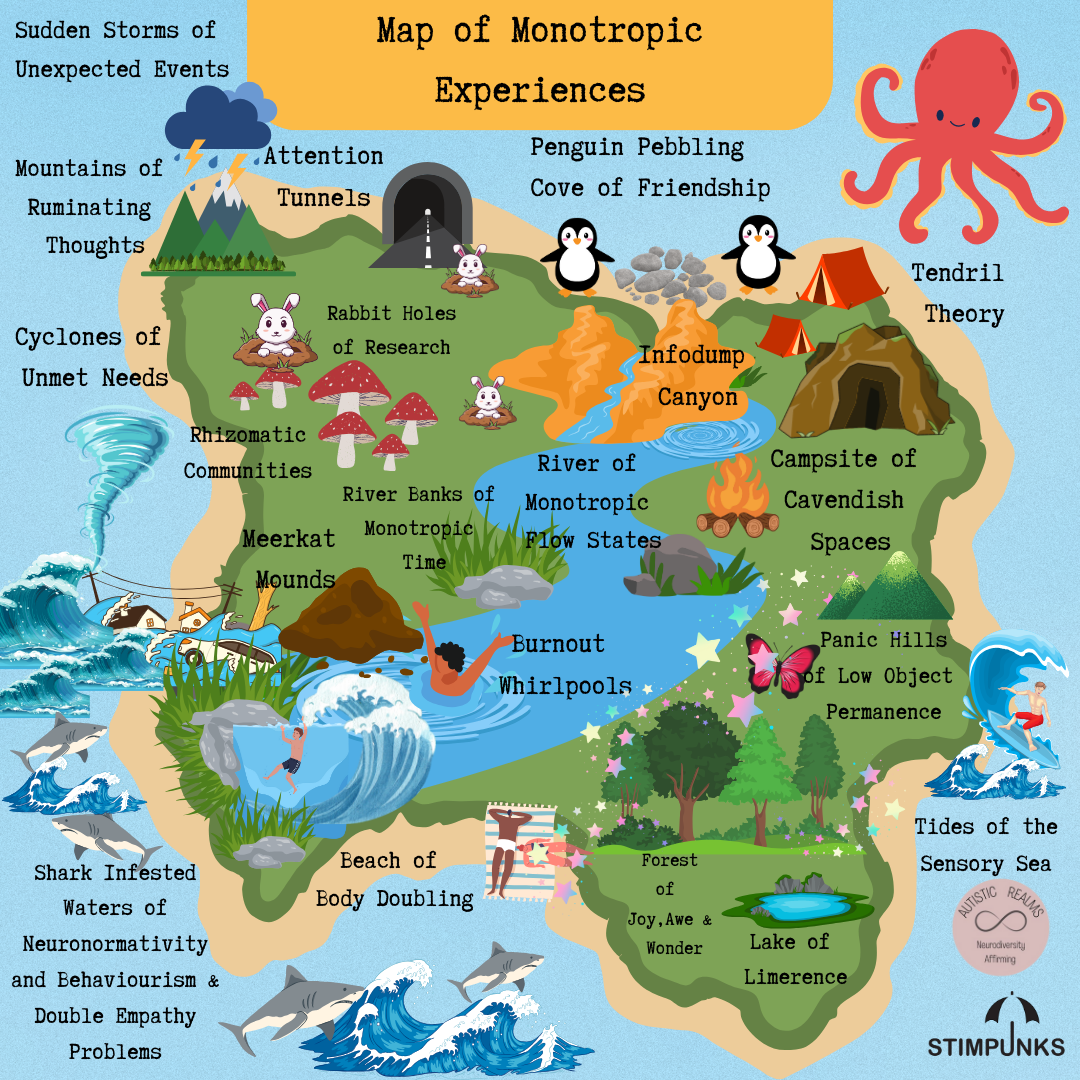
In my Map of Monotropic Experiences, I visualise time being like a river. When we’re in a positive flow, everything just feels right! It can feel like your body and mind are swimming with the current, deeply connected to your passions and environment.
But when the world or other people pull you out of that flow with demands or unexpected disruptions and events, it can feel like you’re swimming upstream, it takes a lot of energy and time to get anywhere and do anything. It’s exhausting swimming against your natural flow and tides and it makes you burn out faster and end up in what I have visualised on the map as burnout whirlpools up against the riverbanks of monotropic time.
Monotropic time isn’t linear. It’s relational, sensory, and fluid, and when you are in the right environment monotropic time can flow with your bodymind. When you experience monotropic time, you are probably in a good place of being able to be deeply engaged in something that is meaningful for you, whether that’s a work project, something to do with your special interests or passions, a sensory experience or a bodily feeling.
Neuroqueering Time
To neuroqueer time means challenging the standard ideas of how we should spend our days based on the views of the majority of society. To neuroqueer, time is to let go of seeing productivity as the ultimate measure of worth and instead honour your authentic identity, be more attuned and aligned with the environment, connect with others and your passions to enable flow.
Nick Walker, in Neuroqueer Heresies (2021), reminds us that neuroqueering isn’t just an identity, it’s a practice and a way of becoming. Neuroqueering is a way of surviving creatively and engaging in flow. Neuroqueer temporality invites everyone, not just Autistic or ADHD people, to explore their own unique relationship with time so they can experience time differently. To neuroqueer time, we have to let go and subvert the expectations of how we think time should be experienced and managed and embrace our own inner rhythm.
Beyond the Clock

Whether you call it monotropic time, spiral time, neuroqueer time, or just “the way I experience things.” Whatever the name, the point is that time doesn’t feel the same for everyone, and that’s okay!
If you’re monotropic, you may embrace a different, deeper rhythm and a way of living that’s more about resonance than routine. Immersing myself in a special interest or engaging in an Autistic passion can often feel like I’m stepping through a portal or falling down into Alice In Wonderland’s rabbit hole. The world outside of my attention tunnel seems to melt away. It can feel like I am escaping reality, but in many ways, it also feels like a return to a safe space and somewhere even more real. Being deep in flow and living in monotropic time can be a really rejuvenating, regulating and restorative experience,
Instead of forcing ourselves into the rigid schedules of neuronormative time, I think we need to create a more safe space for flexibility, deep diving and tunnelling with our special interests and passions. We need to try to let go and resist the demands of neuronormative time so we can have more space to connect with our bodymind and passions and experience the restorative flow of monotropic time.