Tag: monotropism
-

Re-Storying Autism
Re-Storying Autism A Framework For Families, Parents, And Carers: Reimagining Support For Autistic People. #1 Amazon Bestseller
-
Stimming as Embodied Sensory Language
Reframing stimming beyond “behaviour” as embodied sensory language, monotropic flow, and neuroqueer, interdependent connection with the world.
-
The Neuronormative Paradigm: Naming The Systems That Harm
The Neuronormative Paradigm, conceptualised by Nick Walker, names the systems that define and enforce what society considers normal. This exploration piece contrasts the neuronormative paradigm with the neurodiversity paradigm, which recognises all ways of being as vital to human diversity.
-
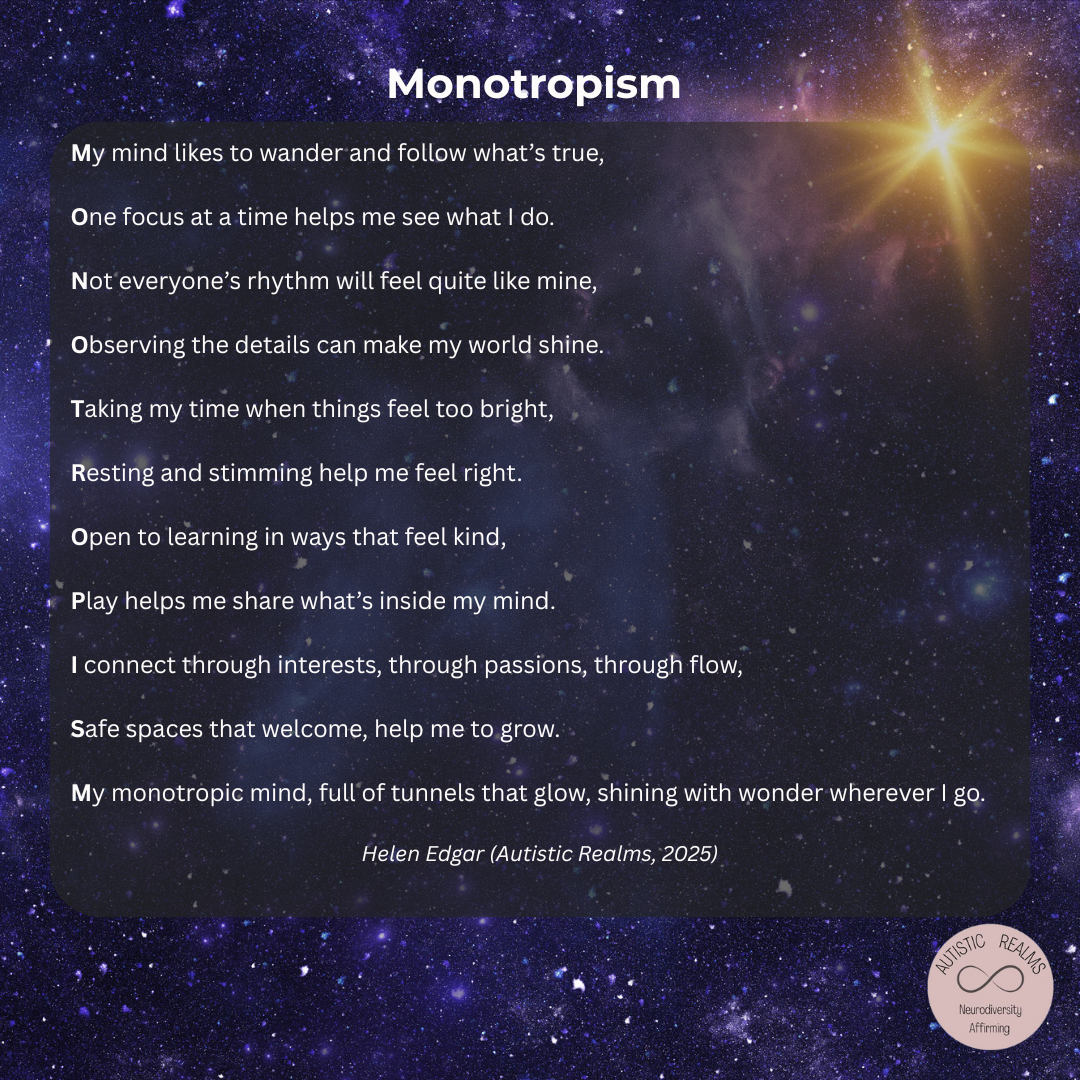
Monotropism: A Poem
A poem about monotropism for children, young people, families and educators to open conversations about Autistic & ADHD experiences.
-
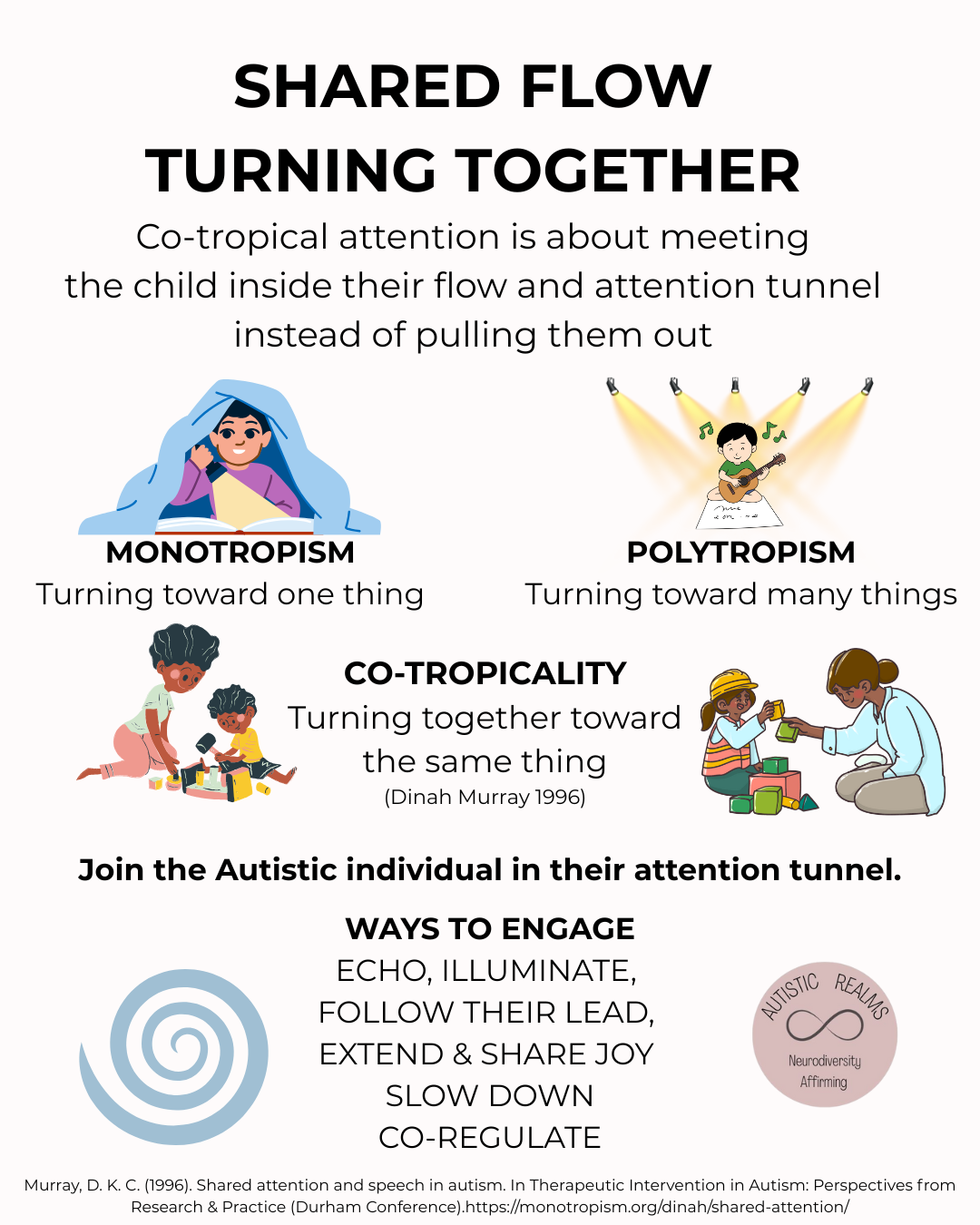
Shared Flow: Turning Attention To Support Children Together
Discover Dinah Murray’s concept of co-tropicality—turning our attention together. Explore how joining Autistic children in their flow builds trust, co-regulation, and deep relational connection through shared focus and joy.
-
Monotropism and Polytropism Explained
Learn how monotropism differs from polytropism, plus research showing ADHDers and AuDHDers score higher on the Monotropism Questionnaire.
-
From Autistic Realms to More Realms: Exploring Other Ways of Being
Journey from Autistic Realms into More Realms—where neuro-affirming support meets creative, sensory, and neuroqueer explorations of other ways of being.
-
Glimmers: Autistic Joy and Monotropism
Glimmers are small, powerful moments of Autistic joy that emerge when we’re deeply immersed in what matters to us. Learn how monotropism & flow create space for joy in an overwhelming world. #AutisticJoy #Glimmers #monotropism
-
Summer Rhythms for Autistic Parents & Carers: Low‑Demand Parenting, Managing Energy & Sensory Needs
A practical guide for Autistic parents and carers to support energy flow, sensory regulation, and family balance through the summer holidays
-
Going Deeper: Rest, Burnout, and Monotropic Flow
Autistic burnout recovery often means going deeper into flow, not switching off. Find out about reclaiming rest through monotropic focus, spiral time, and meaningful immersion.
-
Mingling with the universe: Autistic Perception
Mingling with the Universe” exploring Autistic meaning-making as sensory, felt, and more-than-human, where solitude becomes connection, and the world speaks in textures, rhythms, and resonance. It’s not about escaping, it’s about finding belonging otherwise.
-
Mossy Minds & Monotropism
An exploration of moss and monotropic ways of being. An invitation to slow down, sink in, and reconnect through sensory depth and shared presence in liminal spaces.
-
Autistic Pride: Restorying & Unknowing Autism
Restorying is how we reclaim our Autistic voices, honour our ways of knowing, and build futures rooted in connection, not correction.
-
Monotropism, Spiral Time, and the Rhizome of Memories
Memory may not be linear for neurodivergent people. It may feel like a spiral of felt sensations. Being monotropic shapes how I re-sense moments, navigating echoes and threads of sensory experiences rather than always recalling events.
-
Map of Monotropic Experiences:Training Resources
Map of Monotropic Experiences: FREE Open Source Training ResourcesThe Map of Monotropic Experiences:Reframing Autism Through A Neurodiversity-Affirming Lens Training for Professionals, Families and Community Groups to Support Autistic People I am excited to announce that in collaboration with Stumpunks, we have a new free, open-source training resource!At Autistic Realms and Stimpunks, we believe in telling…
-
Reclaiming Rest: Autistic Burnout, Monotropism, and Resistance
Rest can become a radical act in a world that often equates our worth with productivity, especially for Autistic or otherwise neurodivergent people navigating the tides of burnout, where even our ways of resting may look different.
-
Neuroqueering Monotropic Time: A short summary
Autistic/ADHD people are more likely to be monotropic and resonate with the theory of monotropism. Dinah Murray, Wenn Lawson, and Mike Lesser developed the theory of monotropism in the late 1990s. It is typically described as a neuro-affirming theory of Autism, but I think it is also a temporal mode. I am considering whether being…
-
Neuroqueering Time: Bergson, Deleuze, and Monotropism (an exploration)
Time as a double temporality problem, exploring interest gravity for monotropic people and flow as a temporal home…..
-
Autistic Young People: Skills Regression, Burnout or a shift in Monotropic Attentional Resources?
Autistic individuals may not lose skills but instead redirect their monotropic attention toward new interests or areas of development.
-
Monotropic Time & Neuroqueering Temporalities
Monotropic Time & Neuroqueering Temporalities Dwelling in Resonance: Monotropism, Monotropic Time, Spirals & Neuroqueer Temporalities
-
Challenges for Autistic & Neurodivergent Families Navigating the SEND System: We Need to Understand the Double Empathy Problem & Embrace Monotropism
(Blog based on a presentation I delivered to London Met University 14th March 2025, updated April 24th 2025 following the research published by…. Introduction The Special Educational Needs and Disabilities (SEND) system is designed to support children with additional needs, yet for many neurodivergent families, it presents more barriers than solutions. Families navigating this system…
-
What does ‘neuro-affirming’ mean for Autistic young people?
This blog was written by myself, Helen Edgar of @autisticrealms for GROVE. I am delighted to work with Grove Neurodivergent Mentoring and Education as their Training, Education & Resource Specialist. This blog was edited by Jess Garner, GROVE’sFounder/Director. The blog, ‘What does ‘neuro-affirming’ mean for Autistic young people?’ is available to read on GROVE’s website, along with many other resources and information…
-
Tides of burnout and being monotropic
“Once the storm is over, you won’t remember how you made it through. But one thing is certain. When you come out of the storm, you won’t be the same person who walked in.” [And that may even be a good thing]. (Kafka on the Shore, Haruki Murakami, 2002) Haruki Murakami is one of my…
-
Call for Submissions: Share your experiences of being monotropic.
Open Invite: Share your experiences of being monotropic. Share poems, art, blogs, essays, videos, podcasts, music, etc., that reflect your experience of being monotropic. We will publish across Stimpunks & Autistic Realms as part of our community project. Some stories may be chosen for a community ebook that will be openly licensed; if you would…
-
Words: Inspired By The Experience Of Being Monotropic
Monotropism is a neurodiversity-affirming theory of autism (Murray et al., 2005). Autistic /ADHD/ AuDHD people are more likely to be monotropic(Garau et al., 2023). Monotropic people have an interest-based nervous system. This means they focus more of their attention resources on fewer things at any one time compared to other people who may be polytropic.…
-
Gestalt Language Processing, Monotropism & Young People
Monotropic (Autistic/ ADHD) people have fewer tunnels of interest to process and use their energy than polytropic people (non-Autistic/ADHD). Polytropic people can more easily split their processing and energy resources across multiple channels than monotropic people, this may explain some key differences in communication people experience. It may initially sound a bit conflicting to discuss…
-
Monotropic Interests and Looping Thoughts
The theory of monotropism was developed by Murray, Lawson and Lesser in their article, Attention, monotropism and the diagnostic criteria for autism (2005). Monotropism is increasingly considered to be the underlying principle behind autism and is becoming more widely recognised, especially within autistic and neurodivergent communities. Fergus Murray, in their article Me and Monotropism:…
-
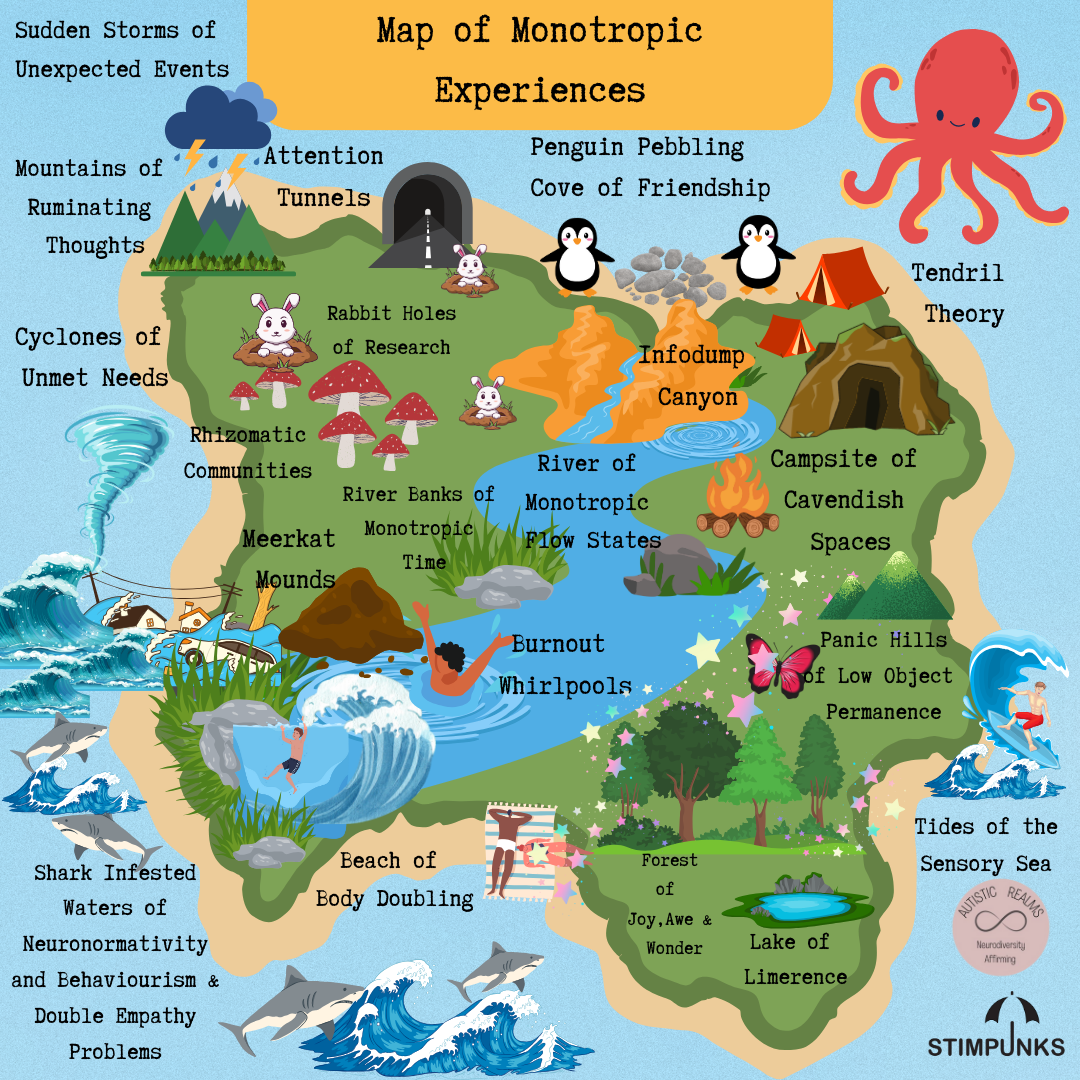
Map of Monotropic Experiences
Monotropism seeks to explain Autism in terms of attention distribution and interests. OSF Preprints | Development and Validation of a Novel Self-Report Measure of Monotropism in Autistic and Non-Autistic People: The Monotropism Questionnaire This map highlights 20 common aspects of my personal monotropic experiences. How many do you experience? Where are you on the map…
-
Autistic Burnout – Supporting Young People At Home & School
Being autistic is not an illness or a disorder in itself, but being autistic can have an impact on a person’s mental and physical health. This is due to the often unmet needs of living in a world that is generally designed for the well-being of people who are not autistic. In addition, three-quarters of…
-
Neurodivergent Base-Camp
Explaining what it is like to be autistic to non-autistic people can be difficult. To quote Dawn Prince-Hughes (Cultural Autism Studies at Yale), being autistic is like “being human without the skin”. This can be difficult for non-autistic people to understand. Seeing and feeling the blank looks and Double Empathy Problem (Milton, 2012) at a…
-
Autistic Burnout, Bodymind and Soul
Kieran Rose (2018) describes autistic burnout as a ‘crash where you keep on crashing’. This resonates deeply. I have experienced cycles of burnout throughout my life due to systemic unmet needs living as an autistic person in a world primarily designed for non-autistic people. The double empathy problem (Milton, 2012) is real, and as explained…
-
Quantum Neuro-Holographic Thoughts from a Liminal Space
“Quantumness tends to prosper in very cold systems that are carefully isolated rather than part of a tepid soup awash with other activity.” (Lewton, T. 2024) This may be a weird take, but … I think we could use the idea of quantumness and reframe it around an interpretation of marginalised groups living on the edges of…
-
Top 5 Neurodivergent-Informed Strategies
Top 5 Neurodivergent-Informed Strategies By Helen Edgar, Autistic Realms, June 2024. 1. Be Kind Take time to listen and be with people in meaningful ways to help bridge the Double Empathy Problem (Milton, 2012). Be embodied and listen not only to people’s words but also to their bodies and sensory systems. Be responsive to people’s…
-
Neuroqueer Collaborative Work Flow Spaces
A behind-the-scenes look into the collaborative workflow between Helen Edgar (Autistic Realms) and Ryan Boren (Stimpunks) as we write about Neuroqueer Learning Spaces (NQLS) and continue our neuroqueering journeys, connecting with awe-inspiring people and discovering new ideas to explore along the way. Liminal Spaces Ryan Boren (Stimpunks) and I are neuroqueering ourselves and the spaces we…
-
An unlearing and relearning journey.
Hello! I have never done an introduction post for Autistic Realms, so after 18 months and some one kindly nominating me for the Positive Role Model Award as part of the National Diversity Awards and receiving so much lovely feedback, I thought I would share a bit about myself! I am Helen Edgar, late identified…
-
Interpreting your Monotropism Questionnaire Results
This information will hopefully provide some clarity for anyone who has taken the Monotropism Questionnaire and are unsure what their results may mean.
-
Autistic Community: Connections and Becoming
Everyone seeks connection in some way or another. Connections may look different for autistic people. In line with the motto from Anna Freud’s National Autism Trainer Programme (Acceptance, Belonging and Connection), creating a sense of acceptance and belonging is likely to be more meaningful for autistic people than putting pressure on them to try and…
-
Monotropism and The Monotropism Questionnaire
This article was originally written for and published by Neurodiverse Connection (Aug 2023) What is monotropism? The theory of monotropism was developed by Murray, Lawson and Lesser (2005) in their article, Attention, monotropism and the diagnostic criteria for autism. Monotropic people focus more attention and energy resources on a more limited number of channels of interest…
-
Embracing Autistic Children’s Monotropic Flow States
Article originally written and published for Neurodiverse Connection (Sept 2023) Autistic and ADHD people are more likely to be monotropic than the rest of the population (Garau, V. et al., June 2023). This means they focus more energy and resources on fewer interests/tasks/ sensory input at any one time compared to non-autistic polytropic people. Developing a…
-
Monotropism, Autism & OCD
This blog has been inspired by Dr Jeremy Shuman’s (PsyD) presentation, ‘Neurodiversity-Affirming OCD Care‘ (August 2023), available here. Exploring similarities and differences between Autistic and OCD monotropic flow states. Can attention tunnels freeze, and thoughts get stuck? Autism research is shifting; many people are moving away from the medical deficit model and seeing the value…
-
Monotropism Questionnaire & Inner Autistic/ADHD Experiences
Post first published 28th July 2023 Over the past few weeks, there has been a sudden surge of interest in the Monotropism Questionnaire (MQ), pre-print released in June 2023 in the research paper ‘Development and Validation of a Novel Self-Report Measure of Monotropism in Autistic and Non-Autistic People: The Monotropism Questionnaire.‘ by Garau, V., Murray,…
-
Monotropism and Experiences of being Monotropic
The theory of Monotropism was developed by Dr Dinah Murray, Wenn Lawson and Mike Lesser (2005) in their article, Attention, monotropism and the diagnostic criteria for autism. Monotropism is increasingly considered to be the underlying principle behind autism and is becoming more widely recognised, especially within autistic and neurodivergent communities. Fergus Murray,(2018), describes montropism as:…
-
Middle Entrance
I am starting my new blog in the middle. I am in the middle of what is known as ‘midlife’ as I am forty-five; I am also mid-career, having resigned from teaching and not yet working in any other defined role. I also live much of my life in and between the online (primarily neurodivergent)…
-
Autism & OCD – What Could Help
According to OCD-UK charity, there are,’ around three-quarters of a million people thought to be living with severe, life-impacting and debilitating Obsessive-Compulsive Disorder (OCD) here in the UK’. Many of these people may also be autistic. Stone and Chen (2015) explain that the co-occurrence rate of OCD in autistic people ‘being 3-7% is 6-14% times the…
-
Monotropism = Happy Flow State
A guest blog for PDA Space – the original more concise version of this article is here: Monotropism = Happy Flow State (thepdaspace.com) As a parent entering into the realms of Autism, ADHD, PDA or any other neurodivergence it can feel overwhelming. Not just because of the weight those labels hold and possible difficulties with…
-
Autism is fluid
Autism is not a disorder and does not need fixing or any ‘interventions’. Autism comes under the umbrella of neurodivergence, it is a different way of thinking, interacting and responding to people and the world. Nick Walker (2021) in her book Neuroqueer Heresies, states; ‘Autism is a genetically-based human neurological variant…..autistic individual’s subjective experience can…
-
Neurodivergent Friendly Classrooms
(Article published as Guest Blog for Twinkl Feb 2023)n Embrace Difference The numbers of pupils needing EHCPs and support plans are increasing in schools, and the numbers of children and young people struggling to attend school due to unmet needs are also escalating. This correlates to the rise in the number of neurodivergent children…
-
Supporting neurodivergent students who are struggling to attend school
Data shows that the number of pupils with identified SEND needs are rising. There is an increase in the number of pupils diagnosed as being neurodivergent e.g. Autistic, ADHD, Dyslexic, PDA or with sensory processing difficulties. We are also in the midst of a huge education attendance crisis demonstrated by the rising numbers of students…
-
Supporting pupils through Autistic Burnout (Neuro-Affirming Teacher Guide)
Supporting pupils through Autistic Burnout (Neuro-Affirming Teacher Guide)
-
Supporting autistic students experiencing OCD in a school setting
The National Autistic Society School report 2021 confirmed, ‘There are over 160,000 autistic pupils in schools across England. Over 70% are in mainstream school, with the rest in specialist education, home educated or out of education altogether’. This figure is likely to be much higher as there are many more who are either on…
-
Autism, OCD, Alexithymia & Interoception
Autism is a difference of neurotype and many autistic people refer to themselves as being neurodivergent. Neurodivergent people process, interpret and respond to the world in a way that is different to the neuromajority /neurotypical person. Obsessive-compulsive disorder (OCD) is characterized by recurrent, unwanted thoughts (obsessions) or repetitive behaviors (compulsions). Some individuals can experience both…
-
Education Crisis – Neurodiversity Affirming Teacher Training Needed
Language Identity First Language: In line with preferences from the Autistic community I will be using Identity First Language (ie. Autistic person, NOT person with Autism) Neurodiversity – This relates to the biological fact that human brains and minds differ from each other. Neurodiversity aligns with the idea that all children are unique and…
-
Supporting Children through Autistic Burnout (Parent/Carer Guide)
(This is written from lived experience as a parent and teacher, supported by the amazing research of professionals and advocates in this field. I’m not a therapist or medical professional). Autistic Burnout: A Family Guide 137 page resource is available in my shop. An updated 2024 version of this article is available here published…
-
Parent ideas for autistic children struggling with school attendance
If your child is autistic, then they are more likely to have additional anxiety, social, communication and sensory processing difficulties. Consequently, school can be a difficult and overwhelming place for them to be if they are not in the right environment with teachers that fully understand them or have the right provision to meet…
-
Ideas for Autistic Children who are Struggling at School
It can be difficult for autistic children to access an appropriate education and challenging for their parents to navigate the various paths to get their child an education that meets their needs. No one wants their child to just survive in school, all our children should be able to thrive in the…