Tag: neurodiversity
-

Weird Pride in a Hostile World
Weird Pride is a practice of becoming. A refusal to shrink. A quiet, feral devotion to staying alive as ourselves in a world that keeps trying to make us something else.
-
The Autistic Rhizome: Community, Liminal Spaces & Belonging
Autistic belonging grows through community, from liminal spaces, not conformity.
-
Re-Storying Autism
Re-Storying Autism A Framework For Families, Parents, And Carers: Reimagining Support For Autistic People. #1 Amazon Bestseller
-
Re-Storying Autism: A New Course & Workbook Now Available!
Re-Storying Autism: A Framework for Families, Parents and Carers Reimagining Support For Autistic People Neurodiversity Affirming Neurodivergent Competent
-
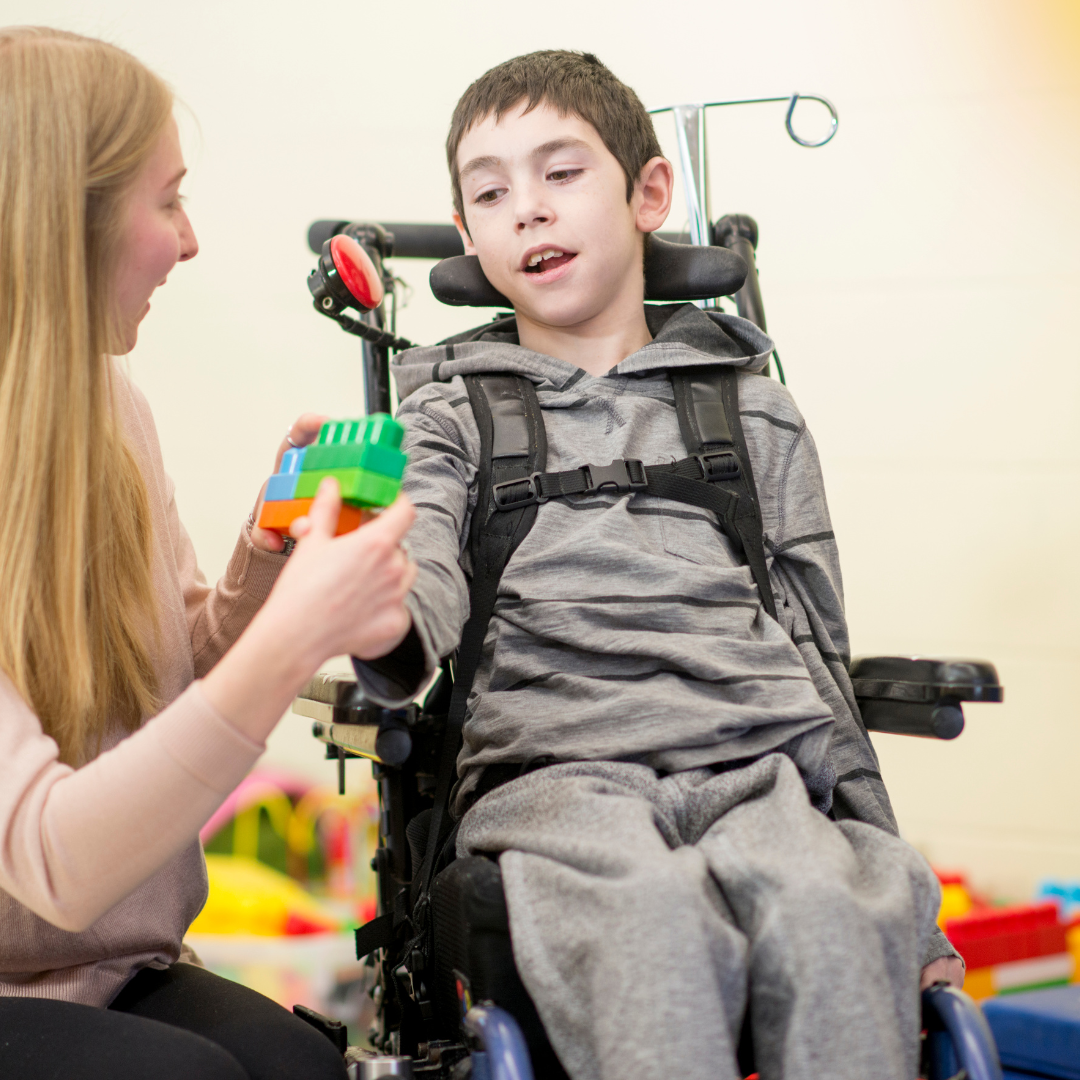
Beyond “Complex Needs”: Neuro-Affirming, Relational Practice with Children with Profound and Multiple Learning Disabilities
A neuro-affirming, relational approach to supporting children with profound and multiple learning disabilities, centred on safety, communication, and being-with.
-
Stimming as Embodied Sensory Language
Reframing stimming beyond “behaviour” as embodied sensory language, monotropic flow, and neuroqueer, interdependent connection with the world.
-
Free 2025 Advent Calendar & Neuro-Affirming Autism Resources
Free 2025 Advent Calendar & Neuro-Affirming Autism Resources
-
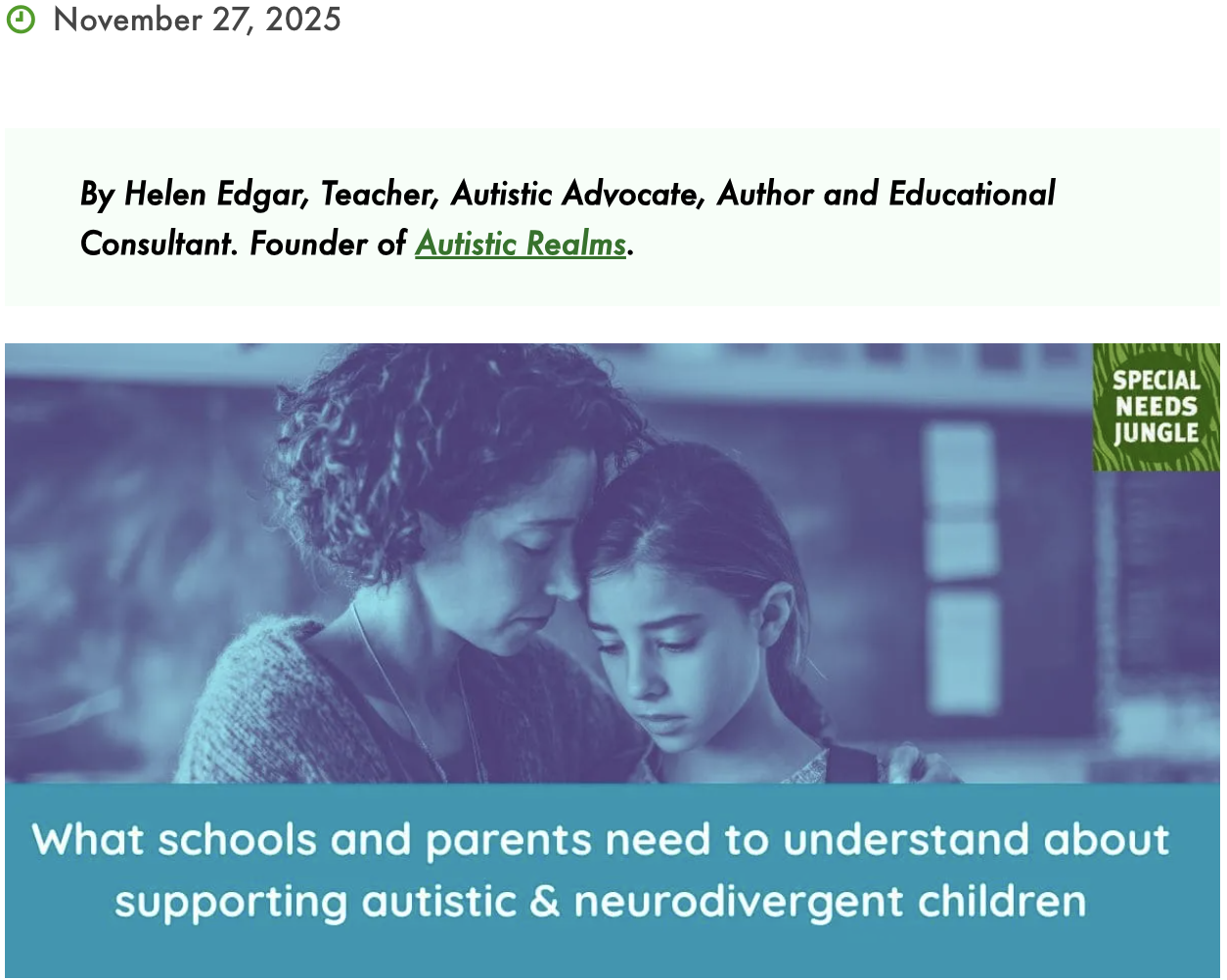
What schools and parents need to understand about supporting Autistic and neurodivergent children
What schools and parents need to understand about supporting Autistic and neurodivergent children
-
Join NeuroHub Community Space
Join me & David Gray-Hammond in our new community NeuroHub. Access to exclusive webinars, resources and space to connect with others! Hope to see some of you there!
-
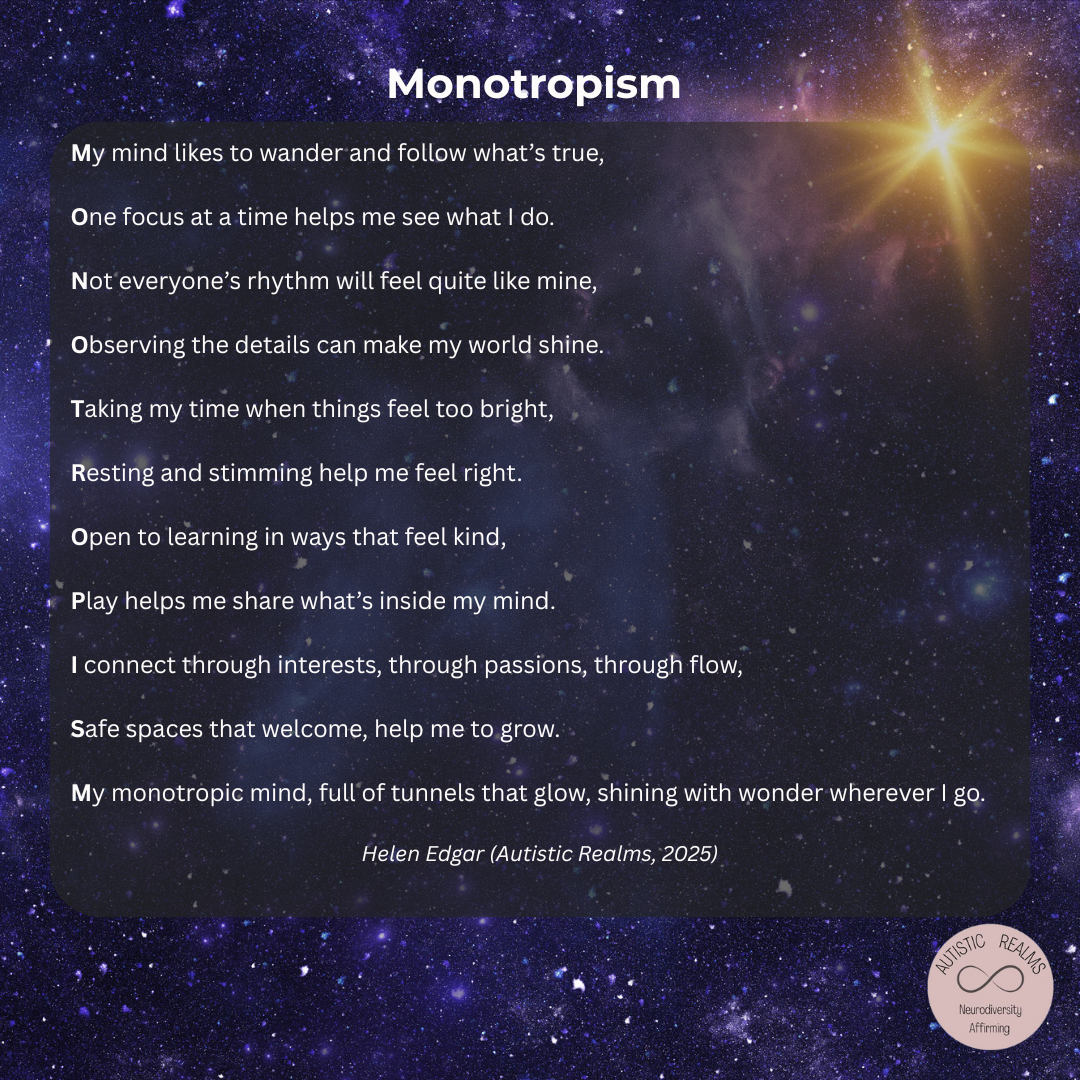
Monotropism: A Poem
A poem about monotropism for children, young people, families and educators to open conversations about Autistic & ADHD experiences.
-
Protecting the Meaning of Neuro-Affirming Practice
Discover what genuine neuro-affirming practice looks like — beyond tokenism and “neurodiversity-lite.” Explore how to protect the heart of the neurodiversity movement and uphold its community-led roots.
-
Discovering Belonging: Creating Neuro-Affirming Animations with Thriving Autistic
Discovering Belonging: Neuro-Affirming Animations with Thriving Autistic. Celebrate Autistic identity through the Discovery Programme and new animations that explore belonging, strengths, and community.
-
Monotropism and Polytropism Explained
Learn how monotropism differs from polytropism, plus research showing ADHDers and AuDHDers score higher on the Monotropism Questionnaire.
-
Neuroqueer Learning Spaces: Free Training for Reimagining Education
Neuroqueer Learning Spaces: Free Training for Reimagining Education By Autistic Realms & Stimpunks Foundation
-
Awe, Wonder and Different Ways of Knowing: Cavendish Space and Helen De Cruz
Honouring the brilliant philosopher Helen De Cruz, whose work on wonder, thinking, and inclusion helped shape and inspire our Neuroqueer Learning Spaces and Cavendish Space. Her ideas continue to guide how we create space for divergent minds to thrive.
-
Mingling with the universe: Autistic Perception
Mingling with the Universe” exploring Autistic meaning-making as sensory, felt, and more-than-human, where solitude becomes connection, and the world speaks in textures, rhythms, and resonance. It’s not about escaping, it’s about finding belonging otherwise.
-
Unmasking: Reclaiming Our Monotropic Attentional Resources?
Exploring masking and unmasking: reclaiming our monotropic attentional resources, reconnecting with ourselves and community
-
Mossy Minds & Monotropism
An exploration of moss and monotropic ways of being. An invitation to slow down, sink in, and reconnect through sensory depth and shared presence in liminal spaces.
-
Autistic Pride: Restorying & Unknowing Autism
Restorying is how we reclaim our Autistic voices, honour our ways of knowing, and build futures rooted in connection, not correction.
-
Being With People with Profound and Multiple Learning Disabilities Through Attunement and Shared Time
There’s something incredibly powerful in the simple idea of being with someone. Not doing to or even doing with or for, but truly being with. For people with PMLD, attunement, emotional connection, and flexible shared time can help to create more space for trust and support wellbeing.
-
Monotropism, Spiral Time, and the Rhizome of Memories
Memory may not be linear for neurodivergent people. It may feel like a spiral of felt sensations. Being monotropic shapes how I re-sense moments, navigating echoes and threads of sensory experiences rather than always recalling events.
-
Sintering: Neurodivergent Community Building
When snow first falls, its flakes are delicate and vulnerable, but over time, a quiet transformation begins. Sintering is the process through which individual snow grains gradually begin to bond. Tiny necks form between them, bridging the gaps, making the snowpack stronger, more resilient, and more resistant to collapse. Sintering In Theory of Water: Nishnaabe…
-
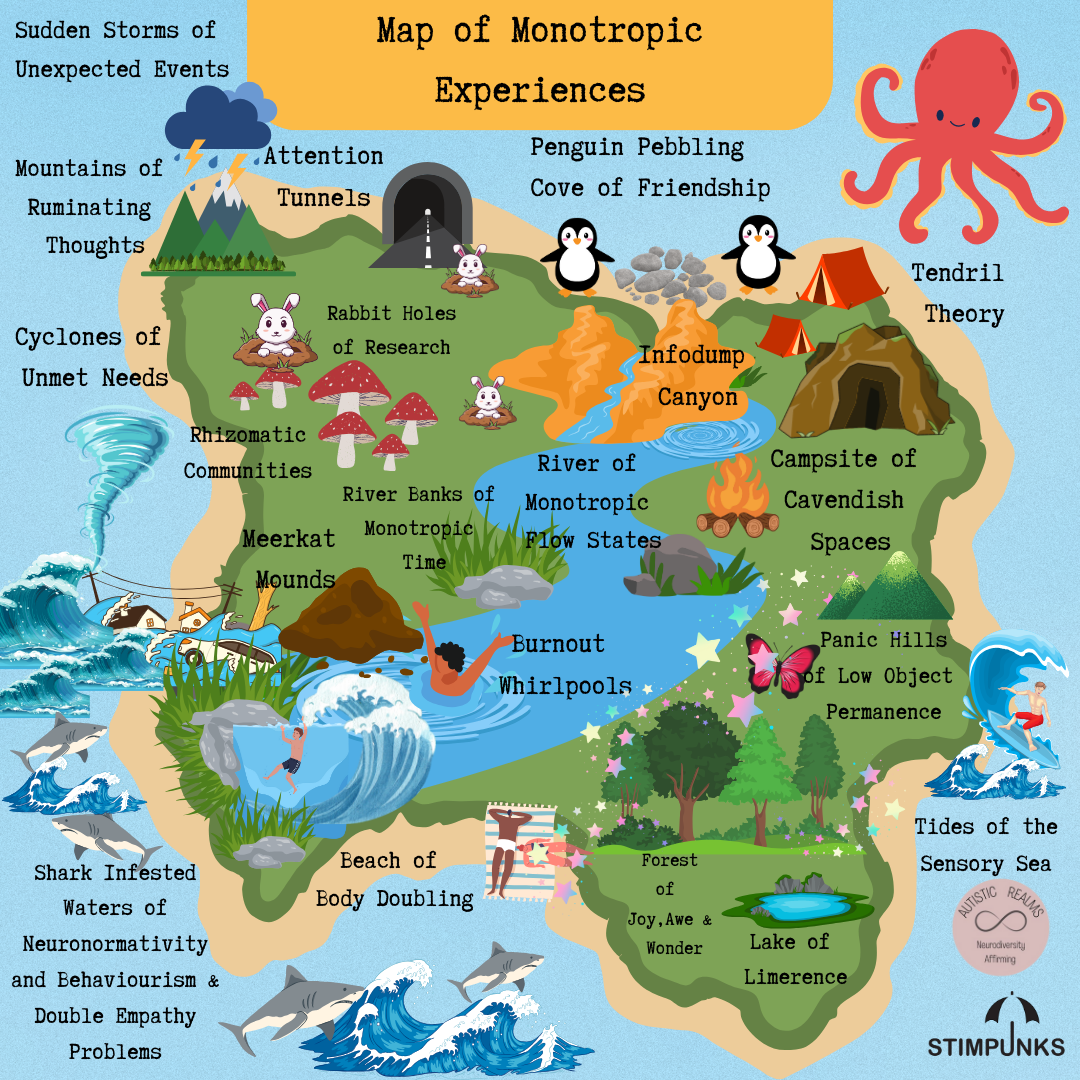
Map of Monotropic Experiences:Training Resources
Map of Monotropic Experiences: FREE Open Source Training ResourcesThe Map of Monotropic Experiences:Reframing Autism Through A Neurodiversity-Affirming Lens Training for Professionals, Families and Community Groups to Support Autistic People I am excited to announce that in collaboration with Stumpunks, we have a new free, open-source training resource!At Autistic Realms and Stimpunks, we believe in telling…
-
Reclaiming Rest: Autistic Burnout, Monotropism, and Resistance
Rest can become a radical act in a world that often equates our worth with productivity, especially for Autistic or otherwise neurodivergent people navigating the tides of burnout, where even our ways of resting may look different.
-
Neuroqueering Monotropic Time: A short summary
Autistic/ADHD people are more likely to be monotropic and resonate with the theory of monotropism. Dinah Murray, Wenn Lawson, and Mike Lesser developed the theory of monotropism in the late 1990s. It is typically described as a neuro-affirming theory of Autism, but I think it is also a temporal mode. I am considering whether being…
-
Neuroqueering Time: Bergson, Deleuze, and Monotropism (an exploration)
Time as a double temporality problem, exploring interest gravity for monotropic people and flow as a temporal home…..
-
Monotropic Time – A Short Blog
Monotropic Time: A Different Rhythm If you are Autistic, ADHD, or AuDHD, time may not feel like a straight line, and you may feel you are constantly battling against the time on the clock. Your internal perception of time may feel more like a spiral, looping, stretching, expanding and contracting, sometimes speeding up and other…
-
Monotropic Time & Neuroqueering Temporalities
Monotropic Time & Neuroqueering Temporalities Dwelling in Resonance: Monotropism, Monotropic Time, Spirals & Neuroqueer Temporalities
-
Monotropic Time
Each person’s experience of time is likely to be influenced by culture, age, disability and neurodivergence. For Autistic/ADHD/AuDHD people, time is anything but linear or neutral and is not a universally accepted given.
-
The Map of Monotropic Experiences: A Summary
The Map of Monotropic Experiences, created by Helen Edgar of Autistic Realms in collaboration with the Stimpunks Foundation, visually represents 20 common aspects of monotropic experience. Monotropism is a theory that seeks to explain autism (and may also resonate with ADHDers) in terms of attention distribution and interests. Our map was originally inspired by Gemma…
-
Map of Monotropic Experiences
Monotropism seeks to explain Autism in terms of attention distribution and interests. OSF Preprints | Development and Validation of a Novel Self-Report Measure of Monotropism in Autistic and Non-Autistic People: The Monotropism Questionnaire This map highlights 20 common aspects of my personal monotropic experiences. How many do you experience? Where are you on the map…
-
Caverns, Pleats and Folds
Cartographers are people who create maps, and they transform physical geography into an accessible format so people can navigate in and through the spaces of the world. I recently watched a National Geographic documentary about caving ‘ Explorer: The Deepest Cave | Disney+ (disneyplus.com’). It led me to consider the underground maps inside the earth, the…
-
Monotropism and Collective Flow
In Milan Kundera’s novel, ‘The Unbearable Lightness of Being’ (1981), he described the heaviness of life, the restrictive oppression and boundaries that can tie us all down, yet there is freedom in the possibilities the mind can bring and in the choices we can make. We can subvert the restrictions of neuronormative society; we can,…
-
Neurodivergent Base-Camp
Explaining what it is like to be autistic to non-autistic people can be difficult. To quote Dawn Prince-Hughes (Cultural Autism Studies at Yale), being autistic is like “being human without the skin”. This can be difficult for non-autistic people to understand. Seeing and feeling the blank looks and Double Empathy Problem (Milton, 2012) at a…
-
Neuroqueering in the Liminal Spaces
Neuroqueering in Liminal Spaces “By silencing our bodyminds, they (neurotypical society) have halted the growth of a chaotic self. We are no longer able to move fluidly through our experience, instead frozen like ice on an arctic tundra” (Gray-Hammond, 2023) David Gray-Hammond (Emergent Divergence) and I are responding to each other’s blogs to help expand the…
-
Neuroqueer Collaborative Work Flow Spaces
A behind-the-scenes look into the collaborative workflow between Helen Edgar (Autistic Realms) and Ryan Boren (Stimpunks) as we write about Neuroqueer Learning Spaces (NQLS) and continue our neuroqueering journeys, connecting with awe-inspiring people and discovering new ideas to explore along the way. Liminal Spaces Ryan Boren (Stimpunks) and I are neuroqueering ourselves and the spaces we…
-
Neurodiversity Affirming Glossary of Key Words – for families and professionals
(Glossary written & and originally published for THE PDA SPACE SUMMIT 2023 ) A full version of The Neurdodiversity Affirming Glossary is now available on Amazon. This blog is an abbreviated version created for The PDA Space. Language Matters It can be really hard as a parent/carer when you discover that your children are…
-
Middle Entrance
I am starting my new blog in the middle. I am in the middle of what is known as ‘midlife’ as I am forty-five; I am also mid-career, having resigned from teaching and not yet working in any other defined role. I also live much of my life in and between the online (primarily neurodivergent)…
-
Autism is fluid
Autism is not a disorder and does not need fixing or any ‘interventions’. Autism comes under the umbrella of neurodivergence, it is a different way of thinking, interacting and responding to people and the world. Nick Walker (2021) in her book Neuroqueer Heresies, states; ‘Autism is a genetically-based human neurological variant…..autistic individual’s subjective experience can…
-
‘Profound’ in relation to those with PMLD / PIMD
PIMD / PMLD The International Association for the Scientific Study of Intellectual and Developmental Disabilities (Profound Intellectual and Multiple Disabilities – IASSIDD) supports individuals and their families who have profound intellectual and multiple disabilities (PIMD). They define this group of people by saying that ‘they are characterized by very severe cognitive, neuromotor and/or sensory…