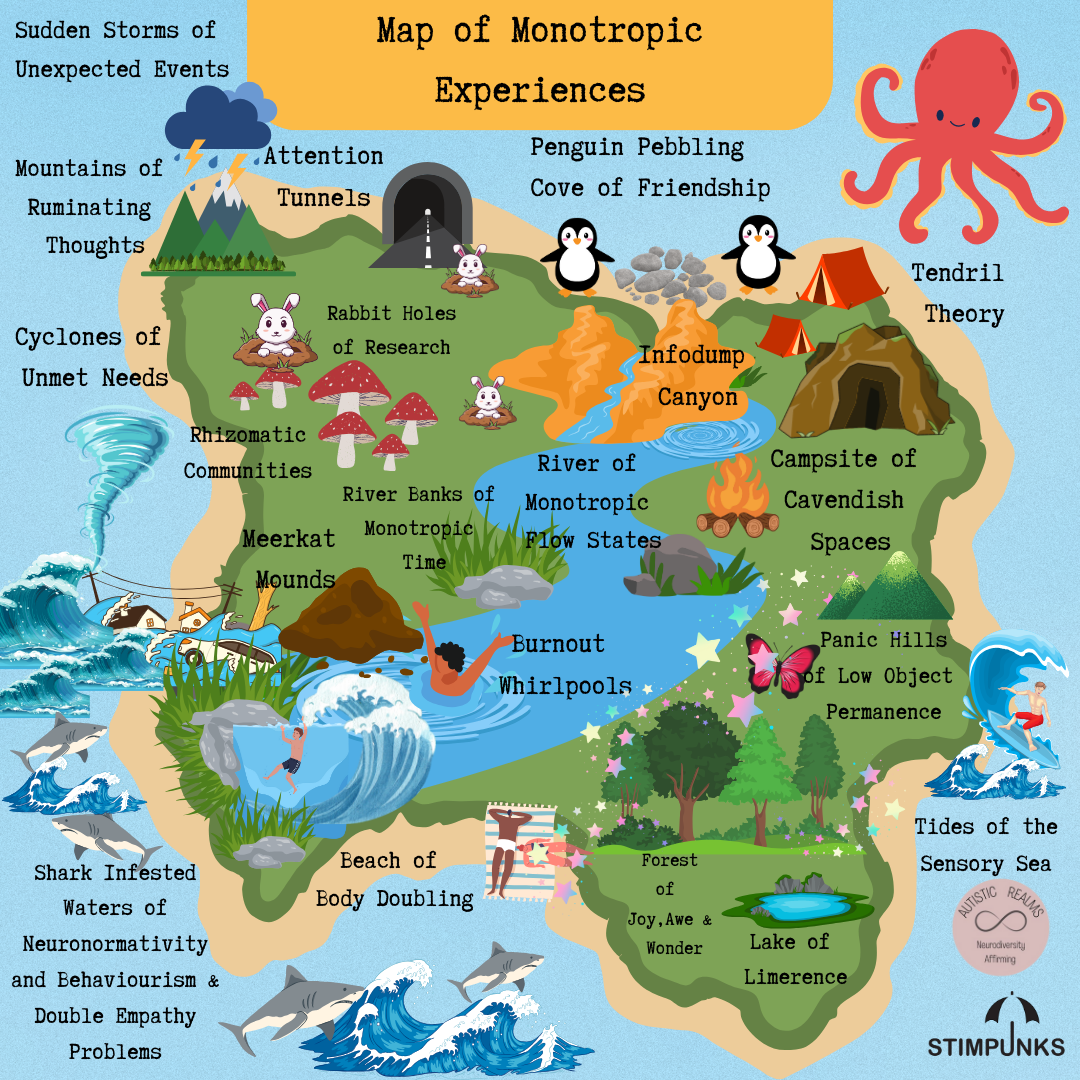
Monotropic (Autistic/ ADHD) people have fewer tunnels of interest to process and use their energy than polytropic people (non-Autistic/ADHD). Polytropic people can more easily split their processing and energy resources across multiple channels than monotropic people, this may explain some key differences in communication people experience.
It may initially sound a bit conflicting to discuss Gestalt Language Processing (GLP) and the theory of Monotropism (Murray et al., 2005). GLP is about understanding and communicating using the ‘whole pattern’ of language, whilst people tend to understand monotropism as Autistic/ ADHD people focusing on details and specifics of patterns/events and not seeing the ‘whole’.
However, for GLPs, the detail could be the whole chunk of language. The whole language pattern could take up more of an attention tunnel for GLPs who are monotropic than those who are not. Potentially this could cause further difficulties for some people if their communication partner is not aware of GLP or monotropism, it could add another layer to the Double Empathy Problem (Milton, 2012). However, if adults are mindful that the young person they are with may be Autistic/ ADHD/ Monotropic and also a GLP, then they can adapt the way they interact to meet their needs so children are more regulated, less stressed, and better able to communicate and learn.
If a child is a Gestalt Language Processor, this could impact them more if they are also monotropic. Other signals that help others communicate are more likely to get missed outside of the attention tunnel for monotropic GLPs. It could mean that children struggle more trying to juggle the multiple streams of information needed for neuronormative communication styles which can result in dysregulation. Polytropic GLPs are more likely to easily pick up on other clues to help them process, understand, and express language and communicate as they learn and play, e.g., body language and facial expressions. Non Autistic/ADHD polytropic people may also be more able to generalise communication used in a wider variety of contexts over time (with support if needed as they learn).
Letting go of expectations for how you feel a child ‘should’ be learning in a certain way that fits into neuronormative ideals can be really rewarding and incredibly beneficial for everyone, not just Autistic/ ADHD monotropic people. We must presume competence when working with children; what may sound like jargon or random phrases to an adult will carry a great deal of meaning for a child if they are a GLP. Going with the flow and having a low-demand approach to learning and play helps all children and will likely help neurodivergent children even more!
There is no right way to communicate, play, or learn. There is no one right way to learn language and express yourself, but there are better neuro-affirming ways for adults to engage with children and create meaning together. Adults need to build a strong, trusting relationship so children feel safer being themselves, engaging, and communicating authentically. We need to enable safe environments and relationships so children can explore, learn, and communicate in ways that suit their individual needs.
Incorporating a child’s passions and monotropic interests into their learning
enhances trust and can strengthen a relationship, as long as their interests are not weaponised into behaviourist approaches and reward systems. Tuning into a child’s unique way of communicating can help them feel a sense of belonging and feel understood. Having a strong trusting relationship enables children to feel safe, and express their needs and wants so they can communicate more effectively.
Low-demand strategies such as parallel play can be really beneficial for Autistic and ADHD people. It allows children to feel a sense of connection but also to be
simultaneously absorbed in their own monotropic attention channel with their chosen interest. Following a child’s lead enables more creative ways for children to explore and express themselves, allowing for deeper engagement and learning potential.
Monotropism may be a reason for some people getting ‘stuck’ in looping thought patterns – and repetitive speech patterns. Monotropic GLPs may hyperfocus on certain patterns and chunks more so than polytropic GLPs due to the way they process and they may find it harder to switch attention channels onto a new focus or pattern. However, if adults are open to different ways of communicating and learning, then children will be better positioned to reach their potential.
We need far more research into GLP and monotropism. GLP is not my area of
expertise, I am a teacher (not a speech and language therapist) but I am curious about this topic and interested in feedback!
Other Things To Consider
It is also worth thinking of how interoception impacts GLP’s (Kelly Mahler has done webinars on this topic).
Does monotropism impact hyperlexic GLP’s in other ways?
How does being a monotropic GLP impact AAC users and also their communication partners?
Does having a learning disability impact GLP and monotropic people further?
There is so much to unravel here; we need more research in this area!
References
Murray, D., Lesser, M., & Lawson, W. (2005). Attention, monotropism and the diagnostic criteria for autism. Autism, 9(2), 139–156. https://doi.org/10.1177/1362361305051398
Milton, D. E. (2012). On the ontological status of autism: the ‘double empathy problem.’ Disability & Society, 27(6), 883–887. https://doi.org/10.1080/09687599.2012.710008
Signposting
https://monotropism.org/
https://stimpunks.org/glossary/gestalt-learning/
Haydock, A., Harrison, L., Baldwin, K., & Leadbitter, K. (2024). Embracing gestalt language development as a fundamental neurodiversity-affirmative practice. Autism, 28(5), 1055–1059. https://doi.org/10.1177/13623613241234598
Rismiller, J. L. (n.d.). Encountering Neurodiversity-Affirming Perspectives of Neurodivergent Experiences: A collaborative exploration with Caregivers – ProQuest. https://www.proquest.com/openview/a1efdc511aa56d87d40f5ac809264c21/1%20?pq-origsite=gscholar&cbl=18750&diss=y
Venker, C. E., & Lorang, E. (2024). Continuing the conversation about echolalia and gestalt language development: A response to Haydock, Harrison, Baldwin, and Leadbitter. Autism. https://doi.org/10.1177/13623613241287577
AMASE (Autistic Mutual Aid Society Edinburgh). (2024, December 8). Speech.exe has failed to load [Video]. YouTube. https://www.youtube.com/watch?v=02kpzIEVkTo
Farnworth, V. (2024, December 2). Autistic Communication Differences: A primer – Reframing autism. Reframing Autism. https://reframingautism.org.au/autistic-communication-differences-a-primer/
Gestalt Learning & Hyperlexia: What Does it Mean to be a Gestalt Learner? (n.d.). And Next Comes L – Hyperlexia Resources. https://www.andnextcomesl.com/2021/08/gestalt-learning.html
Characteristics of the gestalt learner. (n.d.). https://www.homeeddirectory.com/blog/characteristics-gestalt-learner