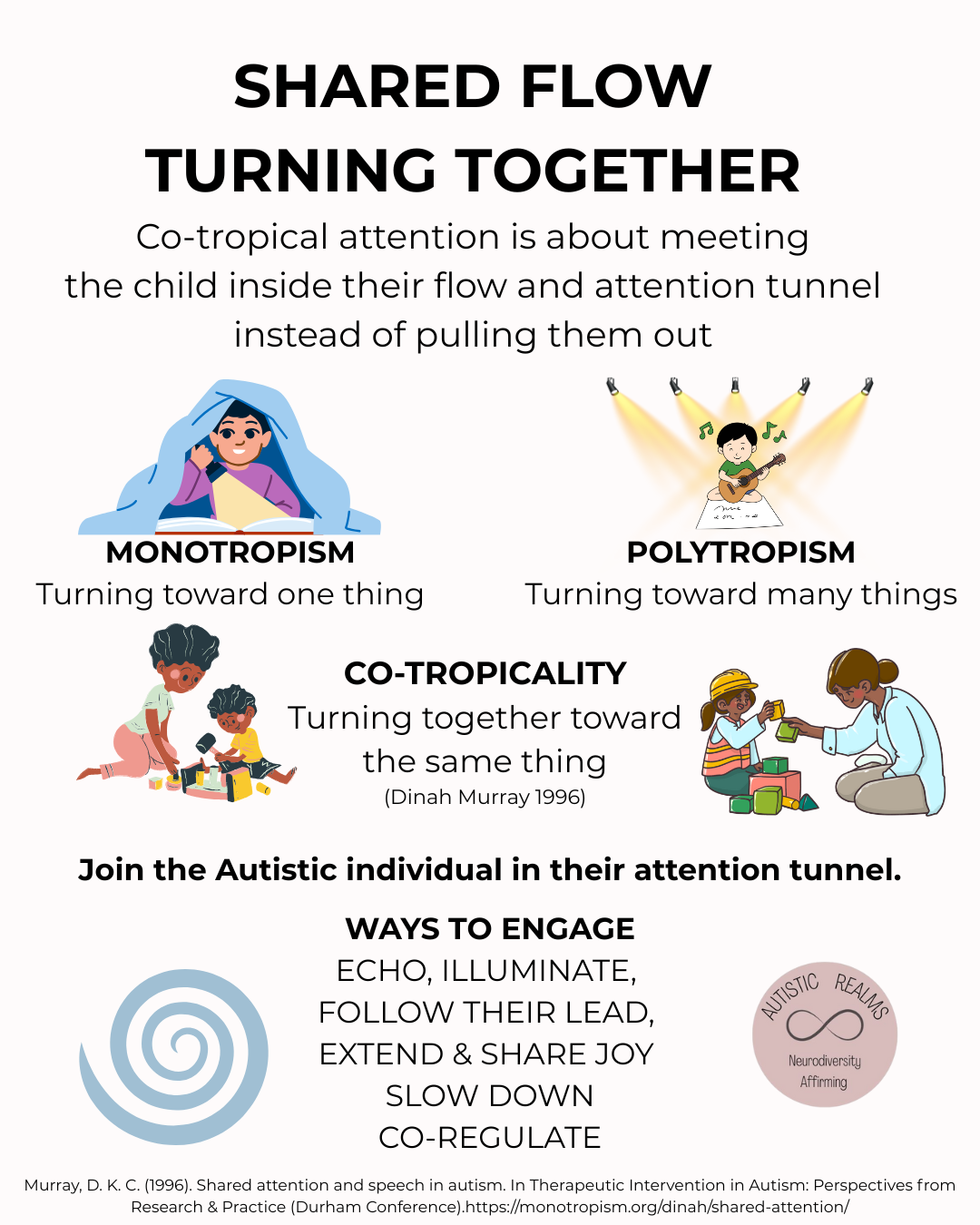
Co-tropicality is Dinah Murray’s (1996) beautiful term for turning our attention together. From the Greek tropos meaning “to turn” it sits alongside monotropism (turning toward one thing) and polytropism (turning toward many). Co-tropical attention means joining someone within their focused attention tunnel and flow rather than pulling them out of it.
Mono-tropism → mono (“single”) + tropos (“turning”) → turning toward one thing.
Poly-tropism → poly (“many”) + tropos (“turning”) → turning toward many thing.
Co-tropical → co (“together, jointly”) + tropos (“turning”) → turning together or turning toward the same thing.Shared flow and co-regulation.
For Autistic or ADHD children, co-tropical attention can look like adults joining in parallel play, sharing in their passions and intense interests, or may be repeating or echoing a familiar script in a meaningful way (for Gestalt Language Processors).
What Murray calls “sensitive co-tropical attention-giving”, is essentially about starting where the child is, meeting them where they are at, aligning with their rhythms and building trust through shared flow. It’s the same principle behind child-led play and intensive interaction – a tuning in with others. It is neuro-affirming, responsive, deeply respectful and will help build trusting relationships.
When we enter a child’s flowy attention tunnel, we can create safety and build connections. When we slow down, we can turn inwards together towards shared meaning-making, moments of joy and learning. Rather than trying to teach or redirect, we need to adopt neuro-affirming approaches, listen with our whole selves and connect with children where they are at in their flow.
Shared flow is relationship-building in motion; it’s a way of saying, I’m with you, right here, in your world, in your attention tunnel. This is the essence of co-regulation and relational flow, co-creating attention tunnels that resonate between people and grounding connection through shared focus.
When we meet a child inside their flow and attention tunnel, we can build trust and a sense of belonging which are the foundation stones for learning and supporting a person’s wellbeing.
if you share our flow
there’s no telling where you’ll go
but you will learn us
(how else will you meet them?)
A Haiku, by @yeshes.online (shared with permission)
References & Find Out More:
Murray, D. K. C. (1996). Shared attention and speech in autism. In Therapeutic Intervention in Autism: Perspectives from Research & Practice (Durham Conference). Retrieved from https://monotropism.org/dinah/shared-attention/
Murray, D., Lesser, M., & Lawson, W. (2005). Attention, monotropism and the diagnostic criteria for autism. Autism, 9(2), 139–156. https://pubmed.ncbi.nlm.nih.gov/15857859/