The workbook (350+ pages) is designed for thoughtful collaborative engagement. You can move through it gradually, dip in and out, and return to sections as needed. It explores: Autistic ways of processing — including monotropism and differences in social understanding. Sensory and emotional experience — the full sensory system (including proprioception, vestibular & interception), overload, regulation and attunement. Burnout — understood as cumulative strain and disconnection, not personal failure. Identity and language — affirming neurodivergent identity and challenging harmful labels. Trauma and safety — recognising chronic stress, intersectionality and the importance of autonomy and predictability. Autistic community knowledge — valuing culture, shared wisdom and lived experience. Each section includes explanations, reflection prompts and collaborative exercises for those supporting Autistic people, Autistic adults and young people (8+). It is intended to support shared learning. The Online ModulesEight recorded video sessions are available inside the Neurohub Community. These sessions deepen the framework through discussion, real-life examples and practical reflection across home life, education, healthcare and workplaces. We talk honestly about masking, exhaustion, sensory strain and identity — modelling approaches rooted in dignity and relational care. You can watch at your own pace, pause when needed and use the workbook alongside if you want to make notes. Who This May SupportThis resource may be helpful for:
A Different Starting PointMuch existing support begins with outward behaviour. We begin with nervous system safety and lived experience. Rather than rewards, pressure or enforced social norms, we explore:
Professional license available for therapists, educators and social prescribers. An InvitationOur hope is that this offering helps ease shame, deepen understanding and strengthen advocacy for Autistic people and their support network. Autistic people flourish when there is safety, agency, sensory consideration and belonging. We would love for you to join us in reshaping the narrative. 📘 Workbook available via Amazon Thu, Feb 19 6:00-7:30pm (GMT) We are grateful to be walking this path together.
Looking forward to sharing more blogs, resources, research and upcoming events soon!
“Community is magic.
|

Resending: Re-Storying Autism: Launching 16th Feb 2026!



Latest Posts
-
Autistic Burnout – Supporting Young People At Home & School

Autistic burnout in young people is real—and recovery starts with understanding. This post offers neuroaffirming ways to spot the signs, reduce demands, and truly support. 💛 #AutisticBurnout #Neuroaffirming #Monotropism #AutisticSupport
-
Monotropic Interests and Looping Thoughts
The theory of monotropism was developed by Murray, Lawson and Lesser in their article, Attention, monotropism and the diagnostic criteria for autism (2005). Monotropism is increasingly considered to be the underlying principle behind autism and is becoming more widely recognised, especially within autistic and neurodivergent communities. Fergus Murray, in their article Me and Monotropism:…
-
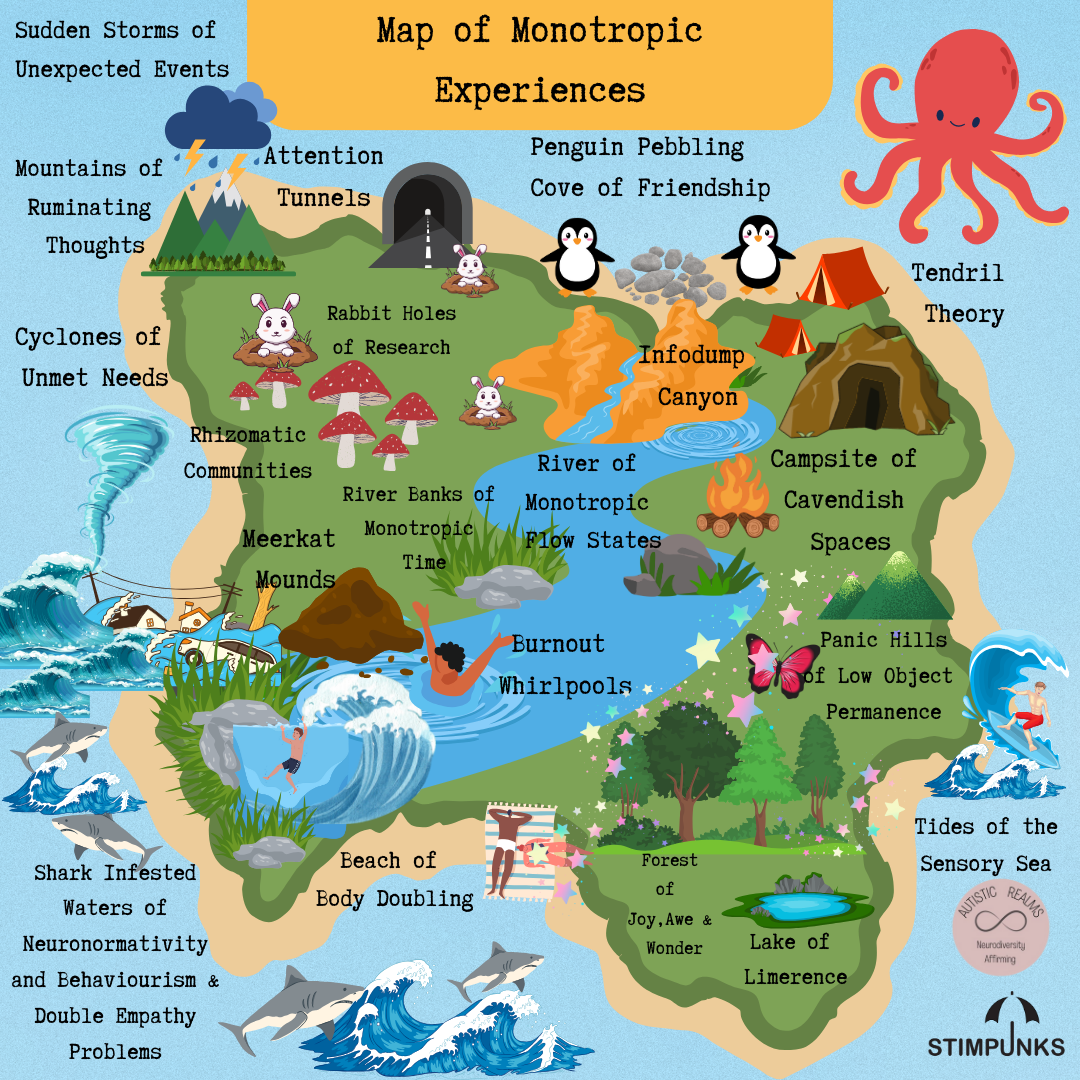
Map of Monotropic Experiences
Monotropism seeks to explain Autism in terms of attention distribution and interests. OSF Preprints | Development and Validation of a Novel Self-Report Measure of Monotropism in Autistic and Non-Autistic People: The Monotropism Questionnaire This map highlights 20 common aspects of my personal monotropic experiences. How many do you experience? Where are you on the map…
-
Autistic Burnout – Supporting Young People At Home & School
Being autistic is not an illness or a disorder in itself, but being autistic can have an impact on a person’s mental and physical health. This is due to the often unmet needs of living in a world that is generally designed for the well-being of people who are not autistic. In addition, three-quarters of…
-
The Double Empathy Problem is DEEP
“The growing cracks in the thin veneer of our “civilised” economic and social operating model are impossible to ignore”, Jorn Bettin (2021). The double empathy problem (Milton, 2012) creates a gap of disconnect experienced between people due to misunderstood shared lived experiences. It is “a breakdown in reciprocity and mutual understanding that can happen between people…
-
Top 5 Neurodivergent-Informed Strategies
Top 5 Neurodivergent-Informed Strategies By Helen Edgar, Autistic Realms, June 2024. 1. Be Kind Take time to listen and be with people in meaningful ways to help bridge the Double Empathy Problem (Milton, 2012). Be embodied and listen not only to people’s words but also to their bodies and sensory systems. Be responsive to people’s…
-
Autistic Community: Connections and Becoming
Everyone seeks connection in some way or another. Connections may look different for autistic people. In line with the motto from Anna Freud’s National Autism Trainer Programme (Acceptance, Belonging and Connection), creating a sense of acceptance and belonging is likely to be more meaningful for autistic people than putting pressure on them to try and…
-
Monotropism, Autism & OCD
Exploring similarities and differences between Autistic and OCD monotropic flow states. Can attention tunnels freeze, and thoughts get stuck?
-
Monotropism Questionnaire & Inner Autistic/ADHD Experiences
Post first published 28th July 2023 Over the past few weeks, there has been a sudden surge of interest in the Monotropism Questionnaire (MQ), pre-print released in June 2023 in the research paper ‘Development and Validation of a Novel Self-Report Measure of Monotropism in Autistic and Non-Autistic People: The Monotropism Questionnaire.‘ by Garau, V., Murray,…
-
Penguin Pebbling: An Autistic Love Language
Penguin Pebbling is a neurodivergent way of showing you care, like sharing a meme or twig or pretty stone to say “I’m thinking of you,” inspired by penguins who gift pebbles to those they care about.
-
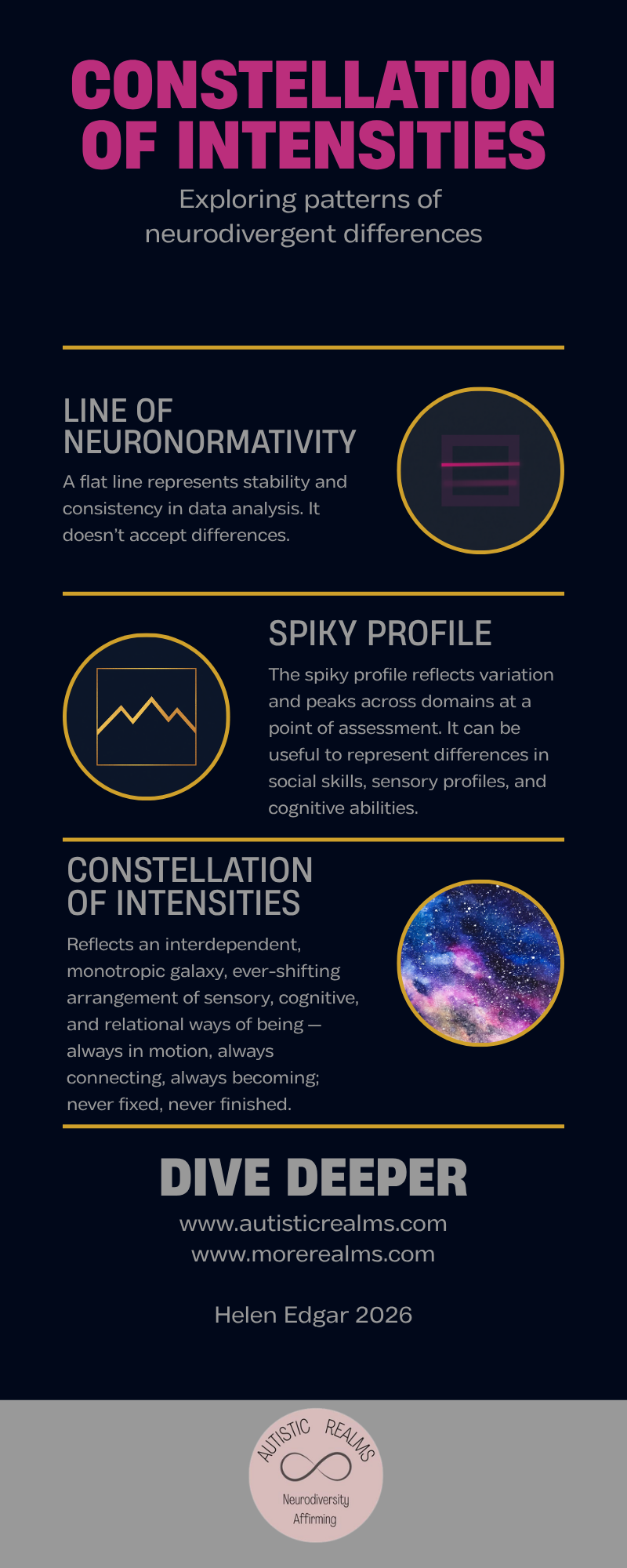
The Constellation of Intensities: Neuroqueering the Spiky Profile
Why even the “spiky profile” still measures us against a grid — and what a constellation of intensities offers instead.
-
Stimpunks Solidarity and Otters
A reflection from Stimpunks Solidarity Sesh on otters, monotropism, and co-regulation, and what watching them together each week teaches us
-
Little Fluffy Clouds: An Invitation To Play
Multisensory Play Ideas: Little Fluffy Clouds Sensory Session