Your basket is currently empty!

Glimmers: Autistic Joy and Monotropism
What Are Glimmers? Understanding Monotropism and How Glimmers Support Autistic and ADHD Well-Being
In a world that often values neurotypical ways of processing and engaging with the world, Autistic and ADHD individuals, like myself, can feel out of sync with our surroundings. Society tends to expect specific patterns of attention, interaction, and adaptability and even pathologises how many of us experience joy.
For many of us, the way we engage is different, it’s deeper, more focused, and sometimes working in a different temporality. This difference can be overwhelming, especially when the world around us is not designed to accommodate our unique ways of being. However, this ability to immerse ourselves fully in the things that matter to us can also give rise to glimmers – small, yet powerful moments that offer grounding and happinness. Glimmers can be lifelines, helping us find meaning, reconnection and joy.
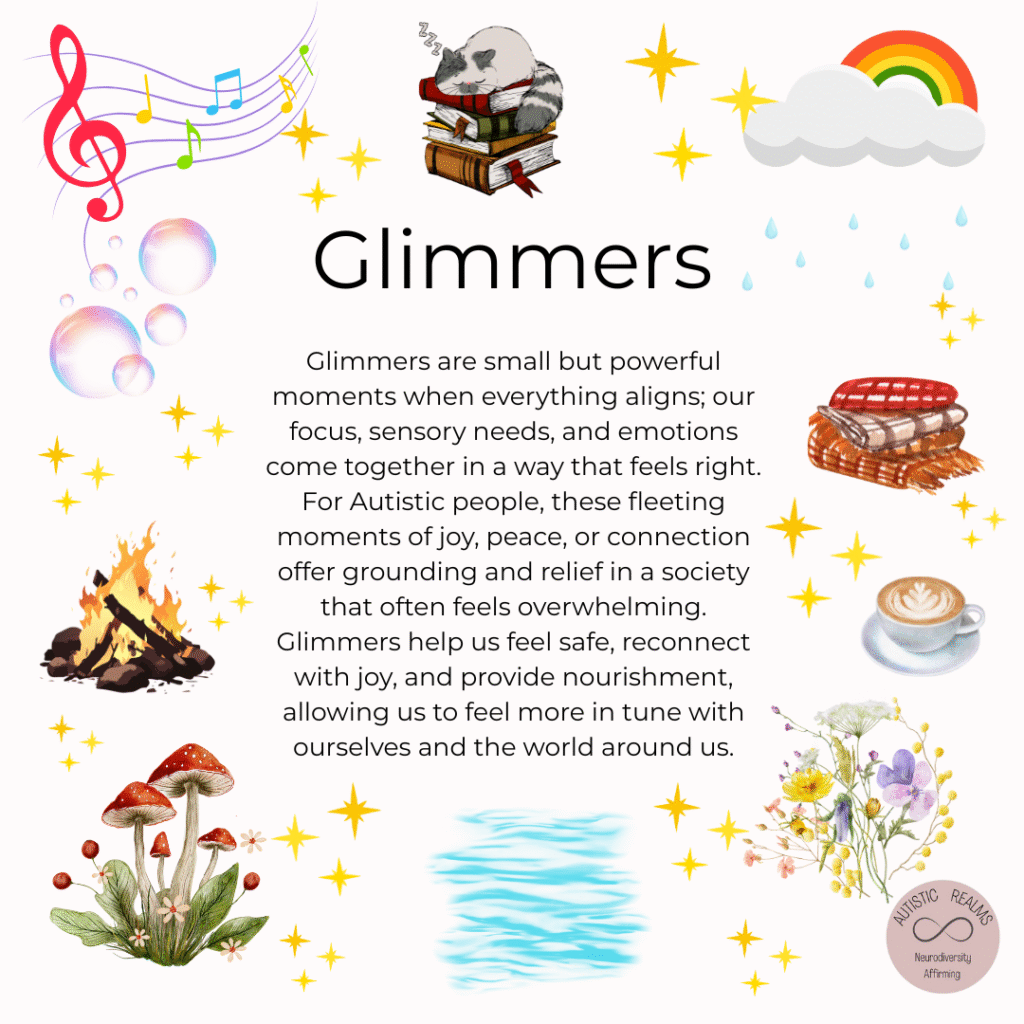
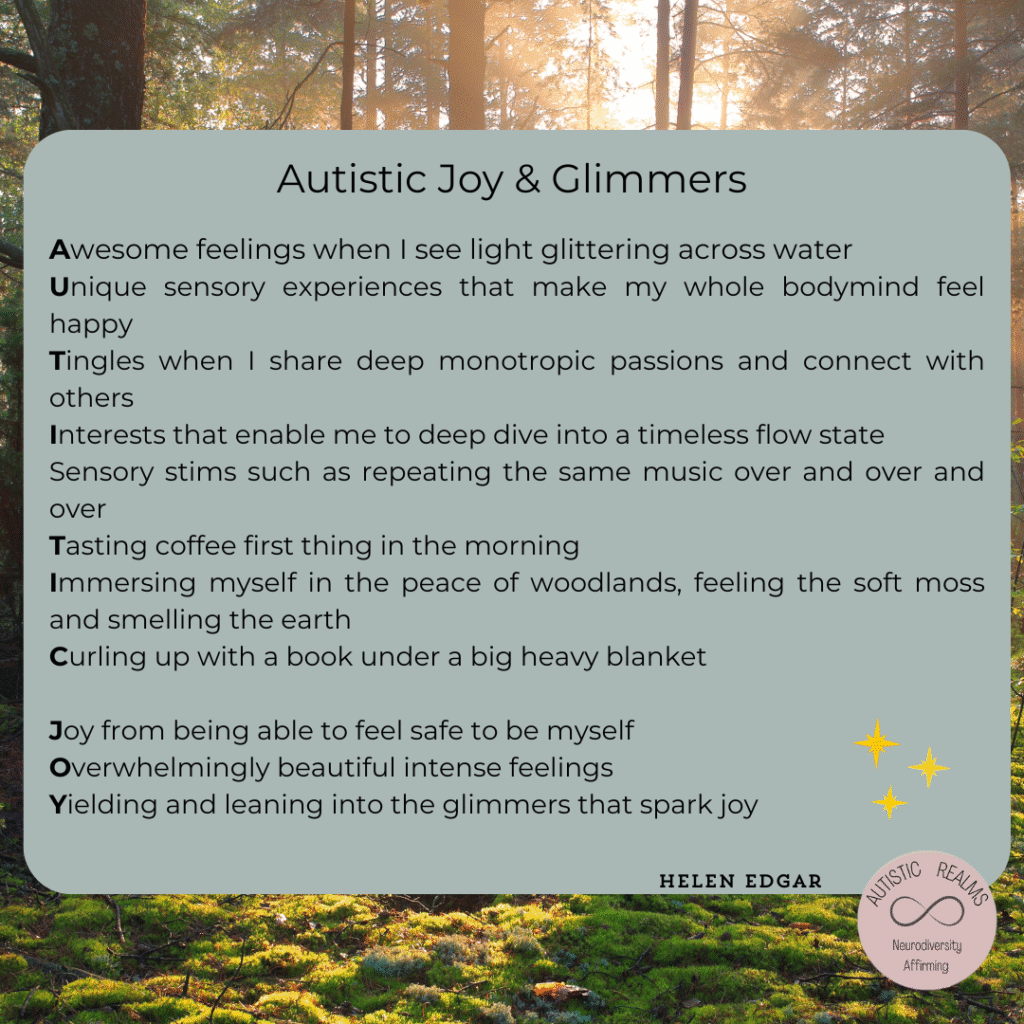
Glimmers are small but powerful moments when everything aligns; our focus, sensory needs, and emotions come together in a way that feels right. For Autistic people, these fleeting moments of joy, peace, or connection offer grounding and relief in a society that often feels overwhelming. Glimmers help us feel safe, reconnect with joy, and provide nourishment, allowing us to feel more in tune with ourselves and the world around us.
Understanding Monotropism and Flow Theory
Monotropism, as theorised by Murray et al. (2005), refers to the way many Autistic and ADHD (Garau et al., 2023) individuals engage deeply with a limited number of things. Unlike the neurotypical way of spreading attention across many tasks or inputs at once (called polytropism), monotropism works differently.
The theory of monotropism helps explain how Autistic/ADHD focus more deeply on fewer things. Instead of dividing our attention (which can be really painful and draining), we engage more fully with meaningful experiences in a deeply immersive way. This might happen through a special interest, a passion project, a sensory experience, in relationships, work, play, or learning. Monotropism supports a more profound connection with life. It allows us to experience joy and fulfilment in ways that may feel different from surface-level excitement or ways people may expect us to feel happy.
Flow theory, as explained by Csikszentmihalyi (1990), further explains how this deep immersion of our attentional resources can lead to satisfaction. When we are able to completely engage in something that aligns with our needs and passions, however briefly, we can enter a state of flow, where we may feel more connected, sometimes challenged, and more able to experience joy. It is in these moments of immersion that glimmers naturally emerge. Monotropic flow opens up a space where we can be fully present, letting go of distractions, and more able to feel a sense of joy.
How Glimmers Contribute to Autistic and ADHD Well-Being
Glimmers are small but deeply powerful moments when everything aligns, our focus, sensory needs, and emotional states converge in a way that feels ‘just right’. These moments may seem insignificant to others, but for many of us, they carry real meaning. A glimmer might be the satisfaction of solving a complex problem after hours of deep focus, the relief of sensory alignment as we splash into a puddle, or find a certain twig or pebble that just feels good!
Glimmers are the opposite of triggers. Instead of leading to negative thoughts, and traumatic memories, they bring a sense of joy. Deb Dana first used the term glimmers to describe “micro-moments of regulation that foster feelings of well-being.” She continues by sharing, ” Once you learn to look for glimmers, you find they are all around, you pay more attention to them, and you naturally begin to look for more. Glimmers are a reminder that ventral energy is always there waiting to be noticed and nourish your nervous system.”
Deb Dana suggests we can all benefit from embracing glimmers and we need to Embrace Glimmer Practice into our lives by adopting the following approach:
See: What are the cues that you have found a glimmer? What happens in your body that lets you know you are in a glimmer moment? What do you do when you feel that spark of energy? What thoughts arise? What emotions do you feel?
Stop: Now that you know the cues, use them to notice glimmers as you move through your day. Glimmers happen regularly, but because they are micro-moments you need to be on the lookout for them. Look for predictable glimmer moments in specific places, with particular people, at certain times. Find the ways glimmers routinely appear. Be open to the unpredictable glimmers that may also appear. When you recognize one of the cues you identified, stop and find the glimmer.
Appreciate: Create an easy way to acknowledge a glimmer as it happens. You might repeat a simple phrase or make a small movement (perhaps your hand on your heart or a finger pointing toward the glimmer) each time you find a glimmer. Notice all the different feelings your glimmers bring. Spend several seconds in appreciation letting the glimmer land in your system.
Remember: Find ways to keep track of your glimmers. Experiment with ways to build your collection and create a personal glimmer library.
Share: When you share your glimmers with someone else, they come alive again in the remembering and retelling. You might text your glimmers to a friend or make talking about daily glimmers a family ritual. You could find a glimmer buddy or create a glimmer group”.

As Bjelland (2023) describes, glimmers “light up the darkness,” offering moments of that help us feel grounded, connected, and in tune with ourselves. Glimmers offer fulfillment, as Wassell (2025) highlights in their research, Autistic joy can be experienced in “the smallest, most unexpected of moments”. These moments are not about grand achievements; they arise from engaging deeply with what resonates with us, with where our attention is being drawn towards and what helps our sensory system feel better.
Glimmers are not just “feel-good” moments, they are more than that, they are moments that signal our sensory system to let us know that we are safe, that we can soften, and that things can feel possible again, even if just for a short while (Farrington, 2023). Whether it’s the comforting hum or bass notes of a favourite song, the warm embrace of a soft blanket, or just being with a loved one in a shared moment and the scent of their perfume, glimmers help us reconnect with joy in ways that are often subtle but deeply nourishing.
How Monotropism and Flow Create Glimmers
Monotropism creates fertile ground for glimmers to arise. When our attention is allowed to focus deeply, whether on a sensory experience, a passionate interest, or a moment of connection, we become fully immersed. This kind of monotropic focus often leads to a state of flow, where we are no longer pulled and split in multiple directions but we are able to be wholly present with what we’re doing. When we are in flow, glimmers, small sparks of joy, comfort, or resonance can surface more naturally.
However, monotropic flow doesn’t just help us notice these moments; it can also support us in shifting out of negative loops or states of inertia. A single glimmer of gaining comfort and sensory joy from feeling your pets fur as you stroke them, or feeling the satisfying crunch of pebbles under your feet as you walk along a gravel path, might gently interrupt a rumination spiral or offer a pause of respite in an otherwise overwhelming day. Glimmers offer a sensory foothold and a thread to follow back to ourselves.
Glimmers as Nourishment and Recovery
Glimmers play an important role in emotional and sensory nourishment, particularly for those of us who experience overwhelm or are in burnout. These small, positive moments can help us recharge and reconnect with ourselves. Glimmers can act as anchors through the day, grounding us and helping us navigate a world that often feels out of sync with how we experience it.
When we experience burnout, it’s because the world’s demands have exceeded our capacity to process and engage. In these moments, glimmers become even more essential to look out for and lean into. They offer restorative breaks, brief, powerful moments that help us regain balance and rebuild our energy.
By recognizing and nurturing glimmers, we create opportunities for joy and self-care. These moments, though small, provide the seeds we need to keep going in an often too demanding world.
The Role of Community and Self-Compassion in Cultivating Glimmers
Building a supportive community and practicing self-compassion are essential in cultivating glimmers. Relationships rooted in mutual understanding, respect, and acceptance create the ideal environment for glimmers to thrive. These relationships not only help validate our experiences but also provide the psychological safety needed to fully embrace joy and connection.
When we are surrounded by people who accept and support our needs, we can experience and also express our moments of joy without fear of judgment. When we share these moments of joy with others, it can deepen our connections further. Engaging in collective flow states, where attention, focus, sensory needs and emotion align, allows us to create glimmers together, enhancing our friendships and enriching our sense of belonging. These shared flow experiences create meaningful bonds, where we are not just witnessing glimmers in isolation but amplifying and expanding each other’s joy. Sharing your glimmers with others who ‘get it’, helps to build a community of mutual care, where the smallest moments of connection have the power to sustain us and strengthen our community.
Self-compassion is important; we need to be kind to ourselves, recognizing the value of small moments of joy and honoring our needs. This is a huge step toward cultivating a healthier, more balanced life. As Wassell (2025) writes, “Autistic joy has revolutionary potential. Potential to rethink what being autistic means in ways that are neuro-affirmative. Potential to develop support and empowerment approaches that work positively with, not against, autistic dispositions. Potential to bring into being a world where autistic people can, not just survive, but flourish on their own terms.” By embracing self-compassion and creating space and time for glimmers, we nurture our well-being allowing us to recover from the demands of the world. The simple act of recognizing glimmers and validating our own experiences can help to give us the strength to keep going, creating the foundation for joy, connection, and radical resilience in our daily lives.
Celebrating Glimmers Together: The Power of Shared Joy
Glimmers are more than just fleeting moments of joy, they are vital to our well-being and connection to the world around us. When we honour this way our monotropic ways engaging, we’re more able to notice and welcome the small moments that soothe, spark joy, or gently guide us back into regulation. By recognizing and nurturing glimmers, we may be able to help prevent the depths of chronic burnout, find ways to support our recovery, and experience more moments of joy in our daily lives to help keep us going.
These small, profound moments remind us that joy is always within reach, even in the smallest experiences, sharing the joy of a specific lyric or bass note in a piece of music with a friend, the scent of our favourite meal being cooked, the feel of our pets fur, the glimpse of raindrops sparkling as they drip down the window as the sun catches them, or the feel of the soft moist grass under our feet. Everyone’s experience of glimmers will be unique – what are your glimmers? What brings you joy?
Let’s seek out and celebrate glimmers, allowing them to nourish us as we move through the world on our own terms.
For more information on embracing your glimmers, check out this amazing resource by Jade Farrington and Teo Byrne:
Neurodivergent Approach to Embracing Your Glimmers.
References & Further Reading
Bjelland, J. (2023). Finding light in the dark: The power of glimmers. Retrieved from https://www.juliebjelland.com/hsp-blog/finding-light-in-the-dark-the-power-of-glimmers
Csikszentmihalyi, M. (1990). Flow: The psychology of optimal experience. Harper & Row.
Farrington, J. (2023). A neurodivergent approach to embracing your glimmers. Retrieved from https://jade-farrington.medium.com/new-download-a-neurodivergent-approach-to-embracing-your-glimmers-7ae1894537ec
Murray, D., Lesser, M., & Lawson, W. (2005). Attention, monotropism and the diagnostic criteria for autism. Journal of Autism and Developmental Disorders, 35(5), 538–546. https://doi.org/10.1177/1362361305051398
Psychology Today. (2023, March). The new language of autism. Retrieved from https://www.psychologytoday.com/gb/blog/the-forgotten-women/202303/the-new-language-of-autism
Stimpunks (2025). Glimmers Glossary Page. https://stimpunks.org/glossary/glimmers/
Wassell, E. (2025). Experiences of autistic joy. Journal of Autism and Developmental Disorders, 55(4), 1234-1249. https://doi.org/10.1080/09687599.2025.2498417
Latest Posts
-
Autistic Burnout – Supporting Young People At Home & School

Autistic burnout in young people is real—and recovery starts with understanding. This post offers neuroaffirming ways to spot the signs, reduce demands, and truly support. 💛 #AutisticBurnout #Neuroaffirming #Monotropism #AutisticSupport
-
Monotropic Interests and Looping Thoughts
The theory of monotropism was developed by Murray, Lawson and Lesser in their article, Attention, monotropism and the diagnostic criteria for autism (2005). Monotropism is increasingly considered to be the underlying principle behind autism and is becoming more widely recognised, especially within autistic and neurodivergent communities. Fergus Murray, in their article Me and Monotropism:…
-
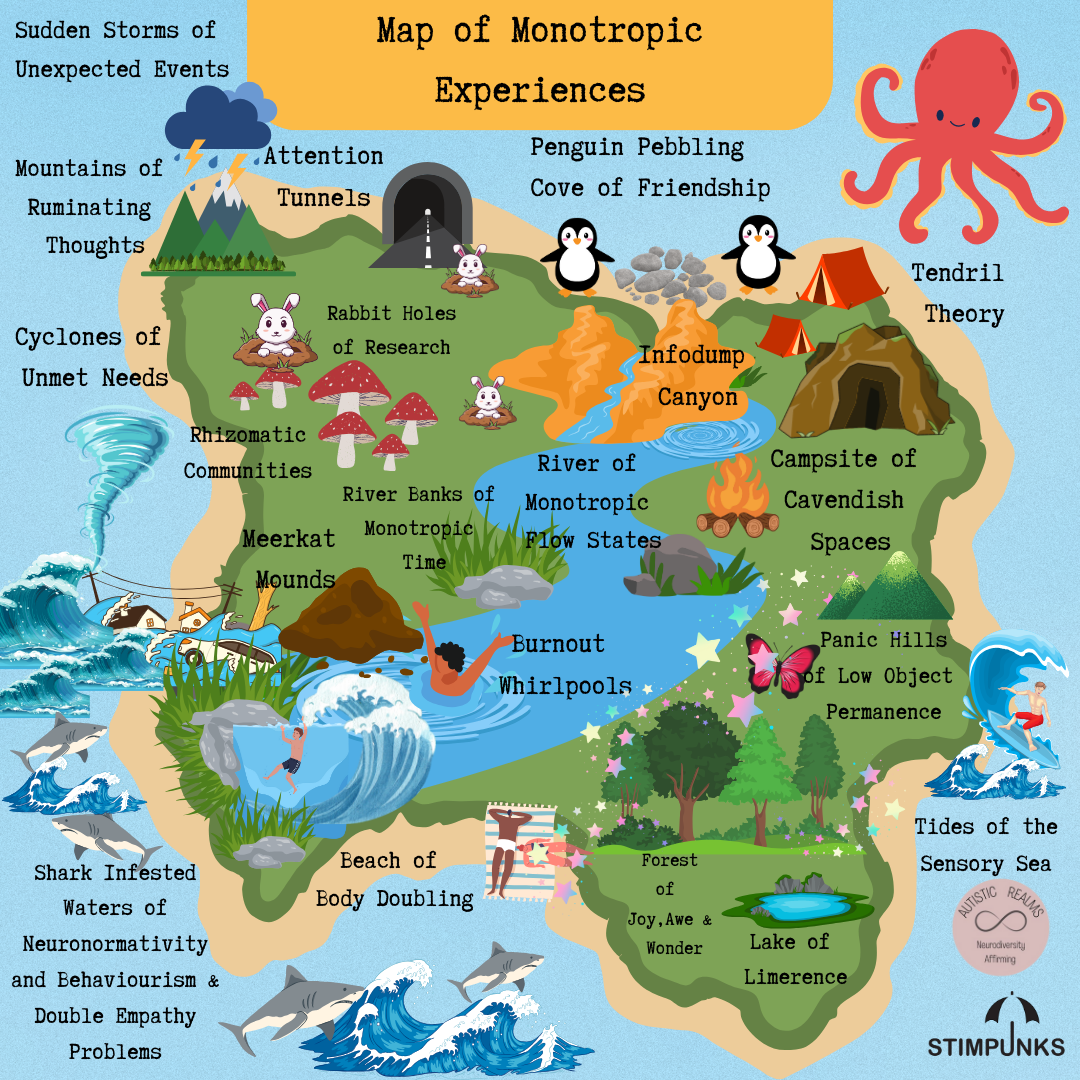
Map of Monotropic Experiences
Monotropism seeks to explain Autism in terms of attention distribution and interests. OSF Preprints | Development and Validation of a Novel Self-Report Measure of Monotropism in Autistic and Non-Autistic People: The Monotropism Questionnaire This map highlights 20 common aspects of my personal monotropic experiences. How many do you experience? Where are you on the map…
-
Autistic Burnout – Supporting Young People At Home & School
Being autistic is not an illness or a disorder in itself, but being autistic can have an impact on a person’s mental and physical health. This is due to the often unmet needs of living in a world that is generally designed for the well-being of people who are not autistic. In addition, three-quarters of…
-
The Double Empathy Problem is DEEP
“The growing cracks in the thin veneer of our “civilised” economic and social operating model are impossible to ignore”, Jorn Bettin (2021). The double empathy problem (Milton, 2012) creates a gap of disconnect experienced between people due to misunderstood shared lived experiences. It is “a breakdown in reciprocity and mutual understanding that can happen between people…
-
Top 5 Neurodivergent-Informed Strategies
Top 5 Neurodivergent-Informed Strategies By Helen Edgar, Autistic Realms, June 2024. 1. Be Kind Take time to listen and be with people in meaningful ways to help bridge the Double Empathy Problem (Milton, 2012). Be embodied and listen not only to people’s words but also to their bodies and sensory systems. Be responsive to people’s…
-
Autistic Community: Connections and Becoming
Everyone seeks connection in some way or another. Connections may look different for autistic people. In line with the motto from Anna Freud’s National Autism Trainer Programme (Acceptance, Belonging and Connection), creating a sense of acceptance and belonging is likely to be more meaningful for autistic people than putting pressure on them to try and…
-
Monotropism, Autism & OCD
This blog has been inspired by Dr Jeremy Shuman’s (PsyD) presentation, ‘Neurodiversity-Affirming OCD Care‘ (August 2023), available here. Exploring similarities and differences between Autistic and OCD monotropic flow states. Can attention tunnels freeze, and thoughts get stuck? Autism research is shifting; many people are moving away from the medical deficit model and seeing the value…
-
Monotropism Questionnaire & Inner Autistic/ADHD Experiences
Post first published 28th July 2023 Over the past few weeks, there has been a sudden surge of interest in the Monotropism Questionnaire (MQ), pre-print released in June 2023 in the research paper ‘Development and Validation of a Novel Self-Report Measure of Monotropism in Autistic and Non-Autistic People: The Monotropism Questionnaire.‘ by Garau, V., Murray,…
-
Penguin Pebbling: An Autistic Love Language
Penguin Pebbling is a neurodivergent way of showing you care, like sharing a meme or twig or pretty stone to say “I’m thinking of you,” inspired by penguins who gift pebbles to those they care about.
-
Presuming Competence: A Neuro-Affirming Reframe To Support Autistic People
When “presume competence” is applied without a neuro-affirming lens, it can become a harmful, ableist expectation
-
Ethics & Values of Autistic Realms
Autistic Realms is grounded in values of authenticity, autonomy, and relational care for the human rights of Autistic or otherwise neurodivergent and disabled people. These guiding principles align closely with the ethics and principles of both the Therapist Neurodiversity Collective (TNDC) and the Autistic Self Advocacy Network (which I am a member of – ASAN),…
-
Inclusion Needs Recognition, Not Erasure: A Neurodiversity-Affirming Approach
When headlines claim that autism and ADHD are “invented labels,” it’s more than rhetoric, it’s erasure. A explores why removing neurodiversity from education would harm the very children inclusion is meant to protect.