“A writer out of loneliness is trying to communicate like a distant star sending signals. He isn’t telling or teaching or ordering. Rather he seeks to establish a relationship of meaning, of feeling, of observing.
We are lonesome animals. We spend all life trying to be less lonesome. One of our ancient methods is to tell a story begging the listener to say — and to feel — ‘Yes, that’s the way it is, or at least that’s the way I feel it.
You’re not as alone as you thought.’”
John Steinbeck (1989). “Steinbeck: A Life in Letters”, p.441, Penguin
The Autistic Rhizome: Community, Liminal Spaces, and Belonging
John Steinbeck writes about his experiences as a writer as being like a “distant star, sending signals” across the dark, not to persuade or instruct, but to reach people, to share the experience of being human. It is as if he is trying to say: this is how it feels to be here, and to wait, with hope and vulnerability, for someone to answer back: yes… I know this feeling too, I get it, I am with you!”
For many Autistic people, that signal is not metaphorical. It is how we learn who we are, by connecting, by sharing stories and through community. It can feel lonely and isolating on this journey by ourselves, but community can offer great support.
Autistic Identity, Loneliness, and Neuronormativity
Our Autistic identity often begins in a world shaped by neuronormative expectations, a world that may feel like it moves too fast, speaks too loudly, values productivity over presence, and treats particular ways of thinking, sensing, communicating, and relating as default. From early on, many of us learn that our natural rhythms do not quite fit. Our ways of being are questioned, managed and corrected. We adapt, we learn to mask, and we have to learn to survive; it can feel lonely and isolating and can lead to deep burnout cycles.
The research by Quadt et al (2024) revealed just how acutely many Autistic people experience loneliness, contradicting the stereotype that we avoid seeking meaningful social relationships. Their study showed, “Loneliness negatively affects physical and mental health in both neurotypical and neurodivergent individuals and rates of loneliness are up to four times higher in Autistic individuals than their peers. Autistic people also have a greater vulnerability to the negative physical and psychological consequences of loneliness. However, social environments often act as barriers, making it more difficult for people with higher levels of sensory differences to interact with others“. Dr Williams added: “Our research highlighted how painfully loneliness is often experienced by Autistic adults. We conclude that to enable meaningful and inclusive social interaction, a real societal effort is needed to create spaces that consider the sensory needs of all neurotypes”.
Community as a Lived, Relational Practice
Our Autistic identity does not disappear under pressure. It is like it goes underground, lies dormant, waiting deep inside until it feels safe to breathe and grow out again, shedding the layers of internalised ableism, feelings of impostor phenomenon, the heavy armour of masking, it takes great energy to re-root from burnout cycles.
This is where community matters as a lived, relational practice. Identity does not form in isolation; it forms through recognition, validation, and connection with others. Through moments where someone may name an experience you thought was only yours and too weird to talk about out loud, or when someone stims alongside you, and you feel safe to join in, or shares their passions and infodumps, or offers you a penguin pebble of joy to say they care and are thinking about you, letting you know that they ‘get you’.
Community grows through shared language, shared pauses, shared sensory ways of being, shared ways of paying attention to the world, shared presence, and through embracing the Neurodivergent Love Languages together, because of our differences!
Colonization is the core wound—the separation from Home. The loss of Home means a disconnect from one’s primary places of connection, and perhaps safety. Home can be a person, place, state of feeling, or thing.
I have heard Home be identified as “a place where people feel like you.”
Dr. Jennifer Mullan
Decolonizing Therapy: Oppression, Historical Trauma, and Politicizing Your Practice (p. 53).
The Autistic Rhizome
David Gray-Hammond and I have been writing about how community spaces can help navigate the journey of discovering your Autistic identity for a few years now, and conceptualised this in our work around the Autistic Rhizome.
Drawing on the work of Gilles Deleuze and Félix Guattari, the rhizome offers a way of understanding identity and connection that does not rely on hierarchy or linear progress. A rhizome does not grow upward toward authority; it spreads sideways, underground, forming networks wherever conditions allow. There is no single origin, no correct path, no final form, much like how our Autistic identity and community connections can begin to unfold, when we feel safe and supported.
Perhaps it begins when you come across a blog post and feel, for the first time, that you are being seen. Or when you read or hear a conversation in an online space where your sensory reality is not questioned or corrected. It is about finding community where you do not have to translate yourself in order to belong. Identity emerges in the spaces between, in-between people, ideas, movements, and care.
Authenticity is our purest freedom.
The Journey of Undoing:
An open letter to who needs it —
SITI Girl Miami
Living under neuronormative domination means that Autistic authenticity often feels risky, and this may be more so for those who are further marginalised. Systems ask us to be legible, manageable, and productive. They reward us when we can perform acceptably and punish us when we cannot. In these conditions, authenticity is not just personal; it is political and a privilege.
As Citi Girl Miami reminds us, as quoted on Stimpunks website, “Authenticity is our purest freedom.” For Autistic people, that freedom is rarely offered outright. It often has to be fought for, it has to be cultivated, gently, collectively, and often from the margins. This is why I think liminal spaces matter so much.
Liminal Spaces and Neuroqueering Belonging
Liminal spaces are not just transitional zones or temporary pauses between more “real” places. They are sites of neuroqueering (Walker, 2021), spaces where dominant logics are unsettled and normative demands lose their coherence (Edgar, 2025). These are the in-between places that exist at the edges of institutions, categories, and identities, where we are not fully inside systems of control, but not entirely outside them either. In liminality, the usual rules do not disappear, but they begin to blur, loosen, and can become negotiable.
For Autistic and neurodivergent people, liminal spaces are often where survival shifts into becoming. They are spaces where we can step out of the constant labour of legibility, the pressure to explain, justify, or correct ourselves in response to neuronormative expectations. In these spaces, identity is not required to resolve into something stable, coherent, or socially acceptable. Instead, it is allowed to remain unfinished, relational, and always fluid, in motion. Liminality makes room for experimentation and differences with sensory needs, communication, presence, pacing, and connection. It allows us to try ways of being that might not yet be possible, or safe, in other environments.
Liminal spaces at the edges of our society and in between systems are charged with possibility because they resist capture. As I explored in Neuroqueering in the Liminal Spaces, these spaces function as sites of quiet refusal, refusing the demand to assimilate, refusing the idea that difference must be resolved or overcome (Edgar, 2025). This refusal is not oppositional in a loud or confrontational sense, it can be subtle, relational, and embodied. It can show up in slowness, in small shifts and gestures, in shared pauses, and in the permission to remain partially unseen if you want.
Liminal spaces do not remove risk, but they can help redistribute it. Risk becomes shared rather than individualised. In these spaces, misattunement does not automatically lead to correction or exclusion and difference is the expected norm!
In this sense, liminality is not something to move through as quickly as possible; it is something to stay with. It is where new relations form, new languages evolve, and new modes of belonging begin to take shape, it is where we can neuroqueer ourselves and our environments and systems.
Cavendish Space: Caves, Campfires And Watering Holes
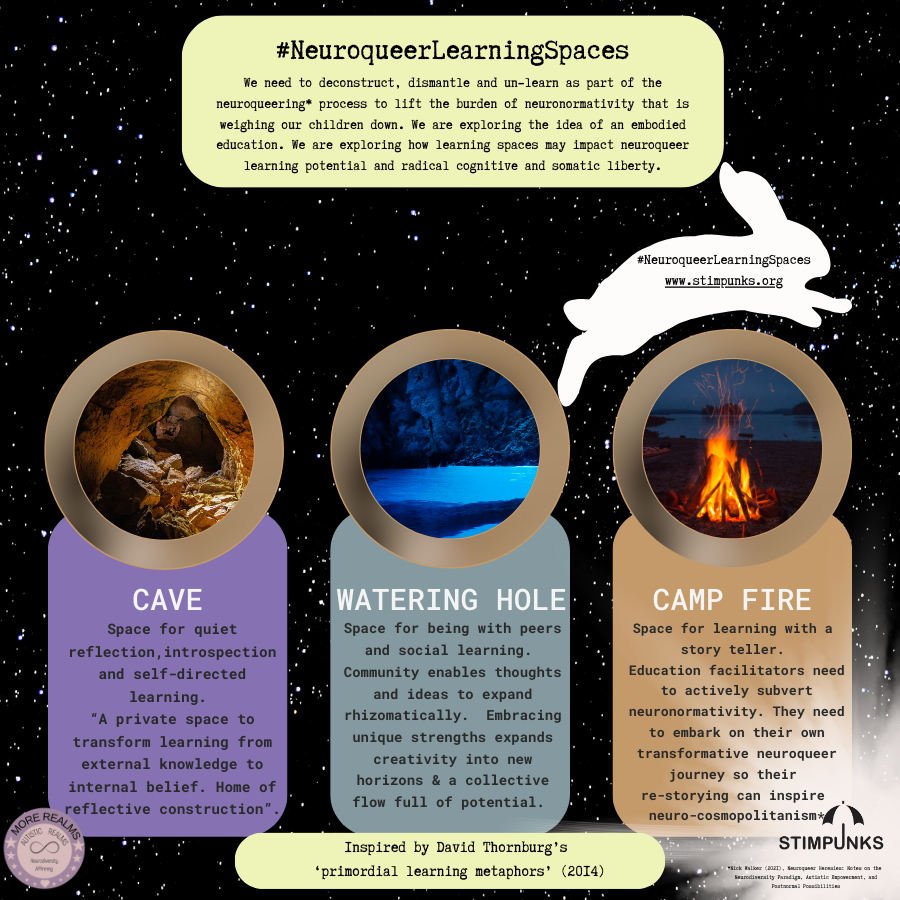
Within the Autistic rhizome, one way this need has been named is through the idea of Cavendish Space, which I have been working on with Stimpunks.
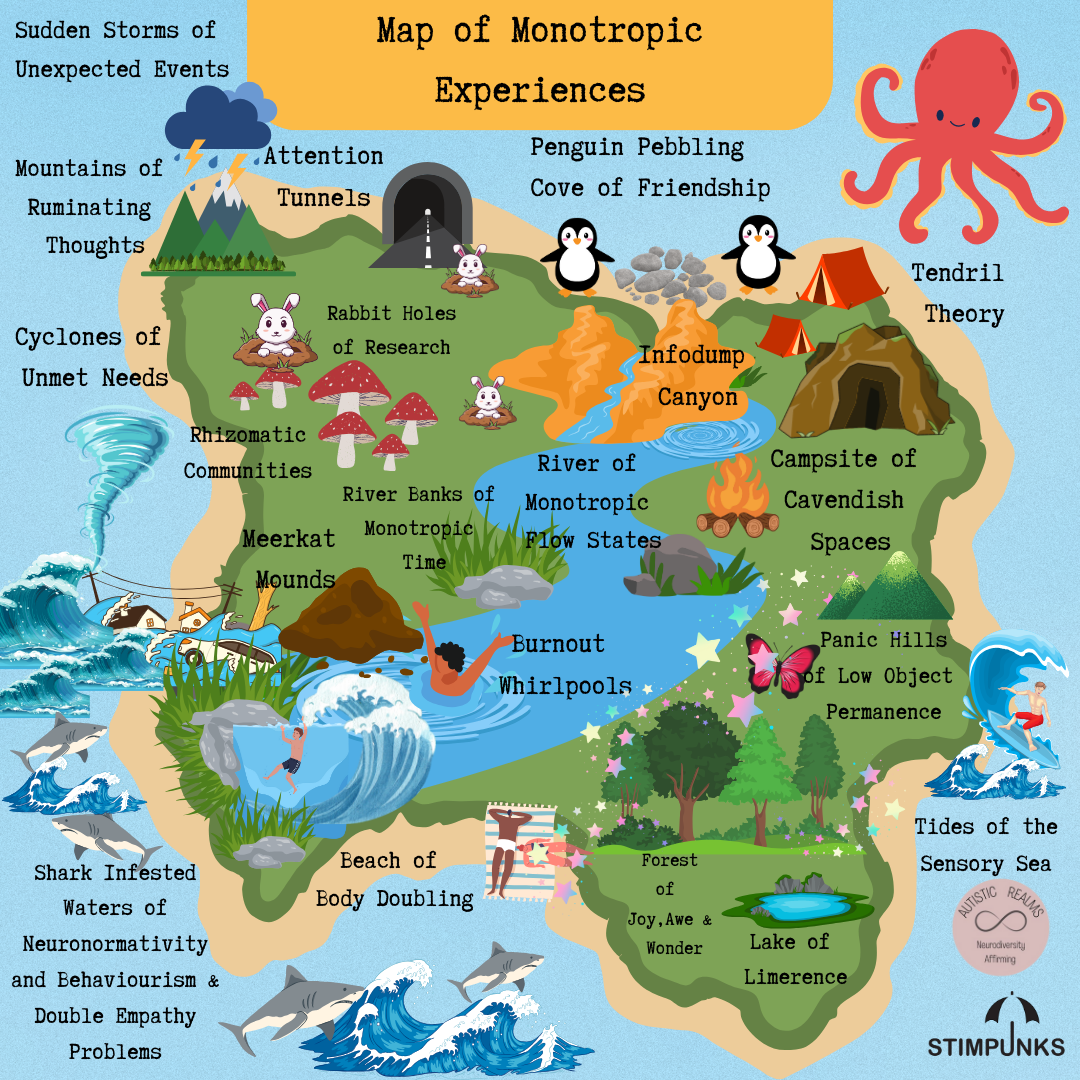
Cavendish Space is the deliberately held space of safety and containment, a psychologically, somatically, sensorially and cognitively safe space where everyone (including Autistic and neurodivergent people!) can exist without performance, without demand, and without the constant pressure to translate themselves into socially acceptable forms. It is a space where attention can settle, where the nervous system can soften, where the self does not have to be defended; it is where we can be liberated as we move between Caves, Campfires and Watering Holes.
Cavendish Space is part of what makes Autistic community possible. Within the Autistic rhizome (particularly online) we do not all gather in the same way, at the same intensity, or for the same reasons. Instead, we move between different kinds of spaces, each meeting our different needs at different times depending on our energy and capacity. One way of understanding this movement is through the metaphors of the primordial learning spaces of caves, watering holes, and campfires.
Caves are places of chosen retreat, where solitude is generative rather than isolating. In caves, Autistic people can think deeply, rest, stim freely, follow interests without interruption, or simply be. These are places where coherence is rebuilt after overload and where identity can settle without external pressure.
Watering holes are our community and social shared spaces. These may be online forums, community threads, or loosely held social spaces where people come and go without obligation. Participation can be intermittent, observational, or asynchronous. Presence alone is enough to sustain connection, and all forms of communication are valid.
Campfires are moments of shared warmth and collective energy, spaces of learning from others and collaboration. Campfires can be deeply affirming, but they are not meant to be permanent, no one can keep up with instruction! Even warmth requires rest, distance, and a return to quieter spaces (Caves) or more social connection (Watering Holes).
What matters is that none of these spaces are treated as superior. Neuronormative culture privileges constant participation, visibility, and responsiveness, often framing withdrawal as failure and solitude as deficit. The Autistic rhizome resists this by recognising that movement between caves, watering holes, and campfires is valid, healthy, necessary, and relational.
Community as Resistance and Survival
On-line Autistic spaces can be especially powerful in this regard for many Autistic people. They allow asynchronous engagement, sensory control, and self-paced participation, making connection possible for those excluded by where they live, health, energy, or other possible access barriers. These spaces are not lesser forms of connection; they are meaningful and valid, and where friendships and a sense of belonging can grow. In-person spaces matter too (socially, in education, and in workplace settings) when they are designed with Cavendish principles in mind: quiet corners, opt-in interaction, freedom of movement, and the ability to leave without explanation. These spaces become embodied extensions of the rhizome rather than sites of enforced conformity.
Within these spaces, resistance is not always confrontational; it often takes the form of care, like choosing slowness, stimming openly, honouring deep interests, infodumping, and being able to express ourselves authentically without fear or judgement. Neuronormativity leans heavily on the myth of independence. Autistic communities quietly undo this myth by valuing interdependence and co-regulation, sharing resources, offering mutual aid, building support, meaning-making, and a sense of belonging together.
Cavendish spaces can be understood as liminal, they are threshold spaces that sit between dominant social worlds and something newly forming. They are not transitional because they are temporary or lesser, but because they loosen the grip of neuronormative time, pace, and performance. In these in-between spaces, Autistic ways of relating, regulating, and belonging are able to emerge without demand for independence or conformity. Liminality here is not absence or waiting; it is a lived, relational space where care, interdependence, co-regulation and meaning quietly take root and can grow.
Autistic experience is diverse and shaped by intersecting identities and access needs. The rhizome holds difference without demanding uniformity, belonging does not require agreement or sameness, it requires safety and room to grow and breath. Community itself is resistance, as Alice Wong reminds us:
“Community is political.
Community is magic.
Community is power.
Community is resistance”.
Alice Wong (2020)
Community offers a shared language for experiences. It allows our Autistic identity to be lived relationally with and alongside others. Steinbeck’s distant star does not stop shining once it is seen, and even fallen light glows. When our differences are accepted, valued and understood they form constellations, patterns that help us orient ourselves in the dark, they strengthen the collective rhizome.
Autistic belonging grows through community, from liminal spaces, not conformity. The Autistic Rhizome is made of these constellations; it grows slowly and quietly from the margins in lots of places I am fortunate to be in. You’re welcome to join us in CASY, Stimpunks, Neurohub Community and Thriving Autistic, or you may have found your own spaces that feel right just for you!
It is wonderful to build connections – please do get in touch if you have your own community space that you’d like to share.
“You are not as alone as you thought”
References
Boren, R. (2026, February 19). The five neurodivergent love locutions. Stimpunks Foundation. https://stimpunks.org/2022/01/22/the-five-neurodivergent-love-languages-2/
Deleuze, G., & Guattari, F. (1987). A thousand plateaus: Capitalism and schizophrenia (B. Massumi, Trans.). University of Minnesota Press. (Original work published 1980)
Edgar, H. (2025, June 24). Neuroqueering in the liminal spaces. Autistic Realms. https://autisticrealms.com/neuroqueering-in-the-liminal-spaces/
Gray-Hammond, D. (2025, June 29). The Autistic rhizome: reclaiming knowledge, rewriting reality. https://www.davidgrayhammond.co.uk/p/the-autistic-rhizome-reclaiming-knowledge
1.
Quadt L, Williams G, Mulcahy J, et al. (2024). “I’m Trying to Reach Out, I’m Trying to Find My People”: A Mixed-Methods Investigation of the Link Between Sensory Differences, Loneliness, and Mental Health in Autistic and Non-autistic Adults. Autism in Adulthood. 2024;6(3):284-299. doi:10.1089/aut.2022.0062
https://journals.sagepub.com/doi/full/10.1089/aut.2022.0062
Steinbeck, J. (1989). Steinbeck: A life in letters (E. Steinbeck & R. Wallsten, Eds.). Penguin.
Stimpunks. (2023). Cavendish space. https://stimpunks.org/glossary/cavendish-space/
Stimpunks. (2023, June 18). Lone-wolfing: The joys of autistic solitude. https://stimpunks.org/2023/06/18/lone-wolfing-the-joys-of-autistic-solitude/
Walker, N. (2021). Neuroqueer heresies: Notes on the Neurodiversity Paradigm, Autistic Empowerment, and Postnormal Possibilities. Autonomous Press.
Alice Wong. Disability justice writings and community advocacy. https://disabilityvisibilityproject.com
Wong, Alice. Disability Visibility: First-Person Stories from the Twenty-First Century. Vintage, 2020, pp. xv-xxii.
https://commonreads.com/book/?isbn=9781984899422
Some Community Spaces
Thriving Autistic.
Neurodivergent-Led support, advocacy, training and more for Autistic adults!
https://thrivingautistic.org/
Cultural Autism Studies at Yale.
Community space exploring, defining, generating, recording and preserving Autistic culture.
https://culturalautismstudiesatyale.space/
NeuroHub Community.
Neurodivergent community connection, support, training and resources.
https://neurohubcommunity.org/
Stimpunks.
Mutual Aid and Human-Centered Learning for Neurodivergent and Disabled People.
https://stimpunks.org/