Top 5 Neurodivergent-Informed Strategies
By Helen Edgar, Autistic Realms, June 2024.
1. Be Kind
Take time to listen and be with people in meaningful ways to help bridge the Double Empathy Problem (Milton, 2012). Be embodied and listen not only to people’s words but also to their bodies and sensory systems. Be responsive to people’s fluctuating needs, adapting and changing plans, resources, and stimuli as needed to help create feelings of safety and a sense of belonging . Help to create sense-making and bring meaning to people’s lives (McGreevey et al. 2024). Many neurodivergent people have different ways of socialising, communicating, working, playing, resting and also expressing love and friendship; this needs to be validated and understood. Enabling time for neurodivergent people to be with their neurokin can be valuable to help promote a sense of belonging and shared understanding.
2. Be Curious
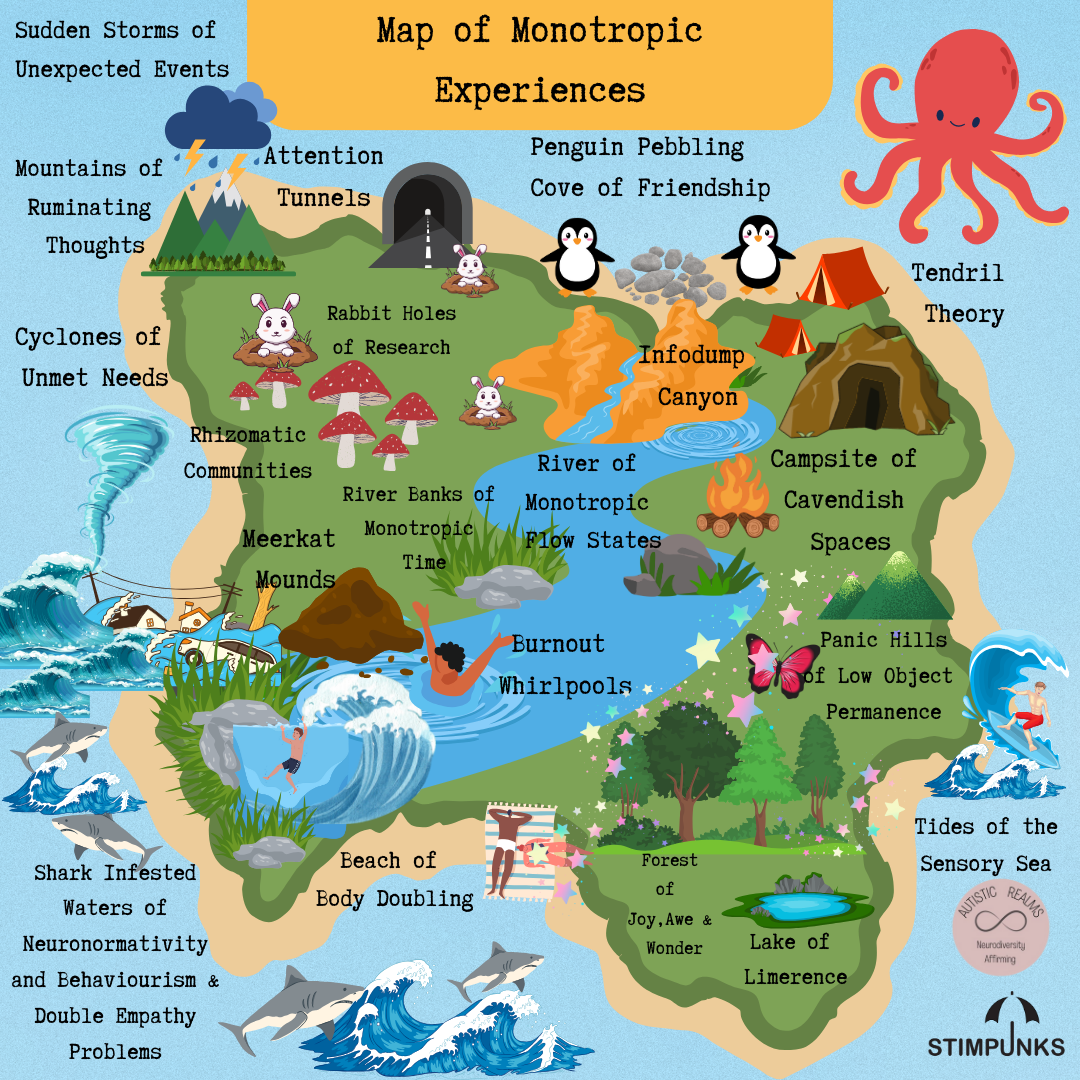
Be informed by the voices of those with lived experience, learn from and act on the neurodiversity-affirming research that is evolving and that validates the inner experiences of neurodivergent people. For Autistic/ ADHD people, this includes understanding how the theory of monotropism and embracing people’s natural flow state can support well-being Murray et al., (2005) and Heasman et al., (2024). We also need to be curious about neurodivergent people’s sensory differences, including the importance of learning about the interoception system and how this may impact people in multiple ways (Mahler, 2015).
3. Be Open
Be open and be compassionate. It has been shown that neurodivergent people are at a higher risk of mental difficulties and suicide (Moseley, 2023). Think about the weight a neurodivergent person carries in a society that values neuronormative ways of being and consider the impact of masking on people’s mental health (Pearson and Rose, 2023). Applied Behaviour Analysis (ABA) and Positive Behaviour Support Strategies (PBS) are often used to try to change neurodivergent people to make them fit into society, but these practices are harmful. A comprehensive list of research and resources demonstrating why ABA and PBS are harmful has been collated by Stimpunks (Boren & Edgar, 2024) as part of our radically inclusive learning spaces project.
4. Be Radically Inclusive
We need a strength-based approach to care and education.Laube (2023) suggested we must acknowledge and respect a person’s neurodivergence, learn how it affects them, and value their unique experiences. We need individualised support instead of using a one-size-fits-all approach. We should try to reduce and challenge stigma and stereotypes and provide radically inclusive spaces for people to thrive in. We need to ensure we have physically and sensory-accessible spaces and places to be that honour different communication needs. SPACE Doherty et al., (2023) is an acronym that encompasses five core autistic needs: Sensory needs, Predictability, Acceptance, Communication and Empathy. Three additional domains are represented by physical, processing, and emotional spaces. This framework encompasses commonalities shared by autistic people, but it is worth considering that if you meet the needs of autistic people, you will likely be meeting the needs of everyone. We need to be radically neuro-inclusive.
5. Be Neurodiversity-Affirming
Take time to read about the neurodiversity paradigm “Neurodiversity itself is just biological fact!” (Walker, 2021); a person is neurodivergent if they diverge from the dominant norms of society. “The Neurodiversity Paradigm is a perspective that understands, accepts and embraces everyone’s differences. Within this theory, it is believed there is no single ‘right’ or ‘normal’ neurotype, just as there is no single right or normal gender or race. It rejects the medical model of seeing differences as deficits.” (Edgar, 2023)
It is essential to have inclusive, accessible communication to meet unique needs and interests. Communication is key to helping people feel empowered to make decisions and have agency and autonomy in their own lives, to feel a sense of pride. Being neurodiversity-affirming is more than changing your language and using the preferred identity first language of the neurodivergent community(Kenny et al., 2016) & (Gray-Hammond, 2024). Being neuro-affirming is about shifting your mindset away from deficit-based approaches that try to change or ‘fix’ a person and is instead about looking at how we can change the environment to meet needs, as advocated for by (Beardon, 2017).
We need to foster kindness, curiosity, openness, and compassion with each other so we can embrace and support each other’s differences. By making neuro-affirming shifts in the way we think, work, and live with others, we can create a better path to support everyone’s journey. Being neurodivergent informed is essential for an inclusive, equitable society that supports everyone’s well-being and creates a sense of belonging.
This blog is also published in: Ways of Being, Knowing and Doing: An Anthology for Neurodivergent-Informed Practice. This is a charity e-book as part of a project to raise funds and awareness of the value of all human voices in our practice and in support of the Palestinian people.
The community has come together to support the Palestinian people. The result is an incredible eBooklet “Ways of Being, Knowing & Doing: An Anthology for Neurodivergent Practice” edited by Lisa Chapman and Kim Mears with contributions from:

- Heba Al-Jayoosi
- Monique Botha
- Lelanie Brewer
- Lisa Chapman
- Helen Edgar
- Warda Farah
- David Gray-Hammond
- Rowena Mahmud
- Elaine McGreevy
- Kim Mears
- Liz Pellicano
- Emily Price
- Tigger Pritchard
- Harriet Richardson
- Kieran Rose
- Bryony Shannon
- Jodee Simpson
- Ryan Boren
- Raelene Dundon
The 31-page eBooklet is a “‘coming together’ of many human voices that explores what it means ‘to Be’ and ‘to Know’ from a neurodivergent-informed, and wholly human perspective. The entries within explore what we can ‘Do’ as humans to support ALL humans, irrespective of ability, race, culture or ethnic background. These words come from diverse experiences of the world but join in a singular focus; to reflect the sanctity of the individual, and to champion what it means to offer neurodivergent-informed care in our practice” (from page 3).
To get your copy, please follow the steps below:
- Donate a minimum of £8 (or equivalent in your currency) to one of the suggested charities outlined below or another charity supporting the humanitarian crisis. If you plan to share the eBook within your organisation, please reflect this in your donation.
- Send an email to NDebooklet@outlook.com with proof of your donation. This can be a screenshot showing you have donated or a receipt from the charity. An audio version will soon be available so please request this in your email if you would prefer.
Upon receiving your proof of donation email, the editors of the eBooklet will send you a PDF of the eBooklet.
Suggested charities:
- Medical Aid for Palestinians: map.org.uk
- Palestinian Children’s Relief Fund: https://www.pcrf.net
- Gift of the Givers: https://giftofthegivers.org
- Palestine Asdiqa: https://linktr.ee/palestineasdiqa
- Gaza Kinder Relief: https://inara.org/gkr
- Action around Bethlehem Children with Disability: abcdbethlehem.org
- Friends of Beirzeit University: https://fobzu.org
Please note: The charities listed above are not associated with this eBooklet offer. The Autism Books by Autistic Authors Project was not involved in the creation of the book and is not the publisher. The website is however, honoured to share this wonderful resource for such an important cause. Please direct all inquiries about the eBooklet to the editors at NDebooklet@outlook.com.
Please share this widely, and thank you!
Kindly hosted by The Autism Books by Autistic Authors Project.