Promotional graphic advertising the “Re-Storying Autism” on-demand video course and workbook. The design features a large headline reading “Re-Storying Autism,” with text stating it is a #1 Amazon Best Seller and now available as Kindle, paperback, and PDF. On the right is a 3D image of the book with a blue cover, a rainbow infinity symbol, and the subtitle describing it as a framework for families, parents, and carers, authored by David Gray-Hammond and Helen Edgar. On the left is a recommendation quote attributed to Kelly Mahler, praising the resource for helping create environments where Autistic people can live with greater safety, dignity, and self-trust, alongside a five-star rating. Branding for NeuroHub Community Ltd appears at the top, and a call-to-action button at the bottom directs viewers to a website link to get a copy.

Re-Storying Autism

A Framework For Families, Parents, And Carers: Reimagining Support For Autistic People

By David Gray-Hammond & Helen Edgar

Book cover titled “Re-Storying Autism.” The background is a muted blue. At the top, the title “Re-Storying Autism” appears in bold yellow and blue outlined lettering. In the centre is a large rainbow infinity symbol in blended shades of red, orange, yellow, green, blue and purple. Below the symbol, the subtitle reads: “A Framework For Families, Parents, And Carers: Reimagining Support For Autistic People.” At the bottom, the authors’ names are listed: David Gray-Hammond and Helen Edgar.

Autism has been explained to us for generations.
Diagnosed, interpreted, measured, corrected, managed.

This course and workbook does something different.

Re-Storying Autism is a number one Amazon Best Seller 2026 , it is an invitation to step out of inherited stories about what autism is and begin shaping your own; one rooted in lived experience, relational safety, and Autistic ways of knowing.

Not a cure.
Not a coping manual.
Not a guide to being more palatable.

This is about meaning, agency, autonomy, and reconnection.

Purchase A Licence For Professional Use Here

Access Course

Licence Holder Access


This isn’t another autism workbook

Most autism resources fall into one of two traps:

They either reduce Autistic life to deficits and strategies,
or they celebrate difference while skirting around burnout, trauma, shame, addiction, and loss.

Re-Storying Autism offers something radically different.

It assumes:

  • Your loved ones have survived environments that weren’t built for them
  • They’re not broken; but they may be carrying the impact of harm
  • Identity is not fixed; it’s shaped over time, in relationship with the world

This course doesn’t ask “How do I function better?”
It asks “What story have I been living inside, and how was it shaped?”

No checklists, no assessments, just a collaborative way of learning about neurodiversity and supporting Autistic people.

Check Out The Workbook & Video Course

Promotional graphic advertising the “Re-Storying Autism” on-demand video course and workbook. The design features a large headline reading “Re-Storying Autism,” with text stating it is a #1 Amazon Best Seller and now available as Kindle, paperback, and PDF. On the right is a 3D image of the book with a blue cover, a rainbow infinity symbol, and the subtitle describing it as a framework for families, parents, and carers, authored by David Gray-Hammond and Helen Edgar. On the left is a recommendation quote attributed to Kelly Mahler, praising the resource for helping create environments where Autistic people can live with greater safety, dignity, and self-trust, alongside a five-star rating. Branding for NeuroHub Community Ltd appears at the top, and a call-to-action button at the bottom directs viewers to a website link to get a copy.


Watch The Webinar To Find Out About Re-Storying Autism Course And Workbook

Endorsements For The Workbook

Image 1 (Blue background – Kelly Mahler review):
A blue graphic titled “Book Review” showing the cover of Re-Storying Autism with a rainbow infinity symbol. Beside it is a positive review by Kelly Mahler praising the book’s focus on sensory experience, interoception, burnout, identity, and belonging. Five stars and a small portrait of Kelly Mahler appear below.
Alt text:

Graphic with a purple background titled “Book Review.” It features the book cover of Re-Storying Autism: A Framework for Families, Parents, and Carers: Reimagining Support for Autistic People by David Gray-Hammond and Helen Edgar. The cover shows a colourful infinity symbol and the title “Re-Storying Autism.” Beside it is a five-star review quote from Dr. Dawn Prince-Hughes, Co-Director of Cultural Autism Studies at Yale, describing the book as “the definitive autistic Bible” and praising it as affirming, resonant, and an antidote to misinformation. Five blue stars appear at the bottom. The word “Review” is written in large script at the bottom right.
Image 2 (Yellow background – Ryan Boren review):
A yellow graphic titled “Book Review” showing the cover of Re-Storying Autism with a rainbow infinity symbol. Beside it is a five-star review by Ryan Boren of Stimpunks highlighting the book’s move beyond deficit-based narratives and its emphasis on authenticity and neurodiversity. A small portrait of Ryan Boren appears
Image 3 (Red background – Emma Welsby review):
A red graphic titled “Book Review” showing the cover of Re-Storying Autism with a rainbow infinity symbol. Beside it is a five-star review by Emma Welsby of Divergent Minds, recommending the book as a compassionate, neurodiversity-affirming resource for families and practitioners. A small portrait of Emma Welsby appears below.

Built on NeuroHub Community Ltd’s six-point framework

This work is grounded in NeuroHub Community Ltd’s six-point framework for supporting Autistic people; a model developed through years of community work, research, education, and lived experience.

The framework understands Autistic wellbeing as something that emerges when we attend to:

  • How Autistic experience is understood and framed
  • The sensory and emotional landscape of the bodymind
  • Identity, masking, and the cost of survival
  • Environment, predictability, and relational safety
  • Power, systems, and institutional harm
  • Connection, meaning, and Autistic ways of becoming

Rather than isolating “the individual” as the problem, this framework recognises that distress is often created between people, environments, and systems.

Re-Storying Autism uses this framework not as a rigid structure, but as a steady ground; one that keeps reflection safe, contextual, and humane.

Order The Workbook

Order The Video Course


What “re-storying” actually means

Re-storying is not positive thinking.
It’s not reframing trauma to make it easier to endure.

It’s a grounded, reflective process of:

  • Making sense of how a nervous system learned to survive
  • Understanding how environments shape distress
  • Separating identity from harm and adaptation
  • Allowing identity to be fluid, contextual, and alive

When the story changes, behaviour often follows; but the aim is not to change observable behaviour, it’s to rewrite the story of autism.that has been passed down to you.


What’s included

The Workbook (nearly 400 pages)

This is not a journal full of prompts and platitudes.
It’s a substantial, structured companion designed for anyone wanting to better support Autistic people aged 8 years or older.

Inside, you’ll explore:

  • Autistic identity beyond diagnostic labels and behaviour lists
  • Masking, burnout, and the long-term cost of adaptation
  • Why “resilience” narratives often deepen harm
  • How systems, power, and services shape lived experience
  • Ways of reconnecting with self without forcing coherence or certainty

You don’t have to move linearly. You can drop in and out, pause, return, skip, and linger.

This work respects Autistic pacing and autonomy.

Order Workbook in Paperback or on Kindle


 The On-Demand Video Course (7 modules)

The video course brings the workbook to life through seven carefully structured modules.

Rather than lectures or instruction, the videos offer:

  • Clear, accessible explanations of complex ideas
  • Reflection without pressure to disclose, perform, or “progress”
  • A sense of being accompanied, not managed

Watch at your own pace.
Pause. Rewatch. Walk away and return.

No deadlines. No targets. No productivity theatre.

Access Video Course Through NeuroHub


Who this is for

This is for those who want to better understand and support Autistic people and help them after:

  • Feeling disconnected from themselves after years of coping
  • Being exhausted by being told to manage or optimise themselves
  • Wanting language for their experience that isn’t medicalised or moralised
  • Carrying complex histories involving trauma, addiction, or marginalisation
  • Knowing that identity continues to unfold across a lifetime
  • Wanting space to reflect without being fixed

You don’t need to be confident, healed, or stable.
You only need curiosity and enough safety to reflect.


Who this is not for

This isn’t for:

  • Parents seeking to change their child
  • Professionals looking for a quick autism explainer
  • Behavioural compliance or “life skills” training
  • Anyone invested in cure narratives

This work starts from the assumption of Autistic dignity.


Why this exists

Across years of community work, consultancy, research, and lived experience, one pattern kept repeating:

Autistic people weren’t failing because they lacked skills.
They were suffering because the stories about them erased context, power, and humanity.

Re-Storying Autism exists to offer a different starting point; one that honours complexity, contradiction, and growth without demanding assimilation.


How to access it

  • Workbook: Paperback and Kindle
  • Video course: On-demand, lifetime access

Sign-Up & Order

The full video course is available for £100.

And if you’re a paid NeuroHub member, the video course is included at no extra cost.


An invitation

You don’t have to re-story an entire life.
You don’t have to reach clarity or closure.

Sometimes the most meaningful shift is letting a story be told differently.

Re-Storying Autism offers space, language, and grounding for that work; held within a framework designed with Autistic people, not imposed upon them.

The story is still unfolding.

Explore Re-Storying Autism


Licencing For Professionals & Organisations

If you are a professional such as a therapist or social worker and would like to purchase a licence to use Re-Storying Autism in your work, we offer the following packages:

Individual Professionals

  • Video Course Only
    • 6 months for £300
    • 12 months for £500
  • Workbook Only
    • 6 months for £125
    • 12 months for £200
  • Video And Workbook
    • 6 months for £325
    • 12 months for £600

Organisations

  • Video Course Only
    • 6 months for £600
    • 12 months for £1000
  • Workbook Only
    • 6 months for £250
    • 12 months for £400
  • Video And Workbook
    • 6 months for £650
    • 12 months for £1200

Purchasing a licence allows you to use the content and distribute it privately with your clients

For organisational licences, please get in contact to build the right package for you.

If you are interested in purchasing a licence for Re-Storying Autism, please get in contact below:

Email

WhatsApp

Guidance For Professionals On Using Re-Storying Autism

A Guide for Therapists, Advocates & ProfessionalsDownload

Promotional graphic advertising the “Re-Storying Autism” on-demand video course and workbook. The design features a large headline reading “Re-Storying Autism,” with text stating it is a #1 Amazon Best Seller and now available as Kindle, paperback, and PDF. On the right is a 3D image of the book with a blue cover, a rainbow infinity symbol, and the subtitle describing it as a framework for families, parents, and carers, authored by David Gray-Hammond and Helen Edgar. On the left is a recommendation quote attributed to Kelly Mahler, praising the resource for helping create environments where Autistic people can live with greater safety, dignity, and self-trust, alongside a five-star rating. Branding for NeuroHub Community Ltd appears at the top, and a call-to-action button at the bottom directs viewers to a website link to get a copy.

Latest Posts

  • Autistic Burnout – Supporting Young People At Home & School

    Autistic Burnout – Supporting Young People At Home & School

    Autistic burnout in young people is real—and recovery starts with understanding. This post offers neuroaffirming ways to spot the signs, reduce demands, and truly support. 💛 #AutisticBurnout #Neuroaffirming #Monotropism #AutisticSupport


  • Monotropic Interests and Looping Thoughts

    Monotropic Interests and Looping Thoughts

    The theory of monotropism was developed by Murray, Lawson and Lesser in their article, Attention, monotropism and the diagnostic criteria for autism (2005). ​ Monotropism is increasingly considered to be the underlying principle behind autism and is becoming more widely recognised, especially within autistic and neurodivergent communities. Fergus Murray, in their article Me and Monotropism:…


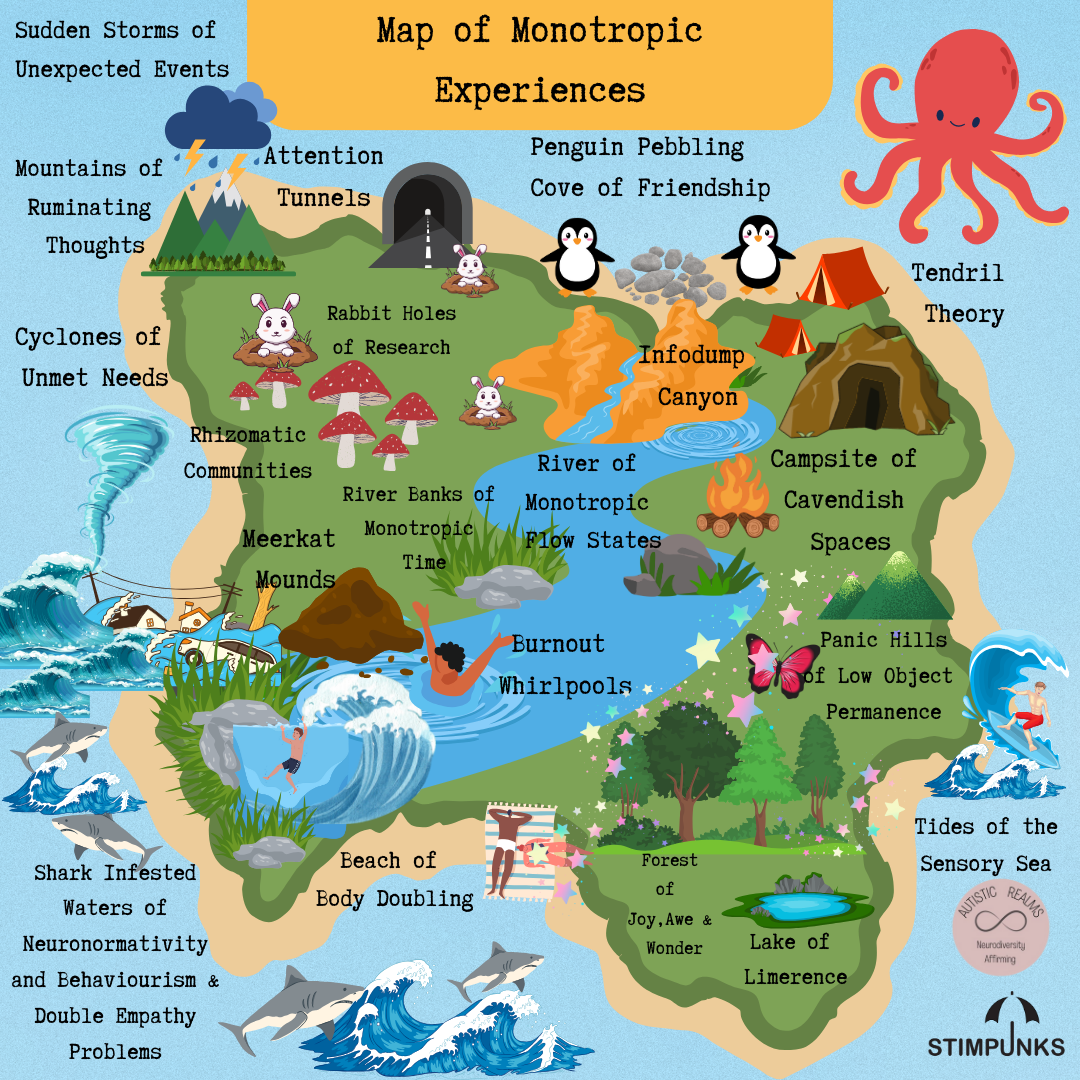
  • Map of Monotropic Experiences

    Map of Monotropic Experiences

    Monotropism seeks to explain Autism in terms of attention distribution and interests.  OSF Preprints | Development and Validation of a Novel Self-Report Measure of Monotropism in Autistic and Non-Autistic People: The Monotropism Questionnaire This map highlights 20 common aspects of my personal monotropic experiences. How many do you experience? Where are you on the map…


  • Autistic Burnout – Supporting Young People At Home & School

    Autistic Burnout – Supporting Young People At Home & School

    Being autistic is not an illness or a disorder in itself, but being autistic can have an impact on a person’s mental and physical health. This is due to the often unmet needs of living in a world that is generally designed for the well-being of people who are not autistic. In addition, three-quarters of…


  • The Double Empathy Problem is DEEP

    The Double Empathy Problem is DEEP

    “The growing cracks in the thin veneer of our “civilised” economic and social operating model are impossible to ignore”, Jorn Bettin (2021). The double empathy problem (Milton, 2012) creates a gap of disconnect experienced between people due to misunderstood shared lived experiences. It is “a breakdown in reciprocity and mutual understanding that can happen between people…


  • Top 5 Neurodivergent-Informed Strategies

    Top 5 Neurodivergent-Informed Strategies

    Top 5 Neurodivergent-Informed Strategies By Helen Edgar, Autistic Realms, June 2024. 1. Be Kind Take time to listen and be with people in meaningful ways to help bridge the Double Empathy Problem (Milton, 2012). Be embodied and listen not only to people’s words but also to their bodies and sensory systems. Be responsive to people’s…


  • Autistic Community: Connections and Becoming

    Autistic Community: Connections and Becoming

    Everyone seeks connection in some way or another. Connections may look different for autistic people. In line with the motto from Anna Freud’s National Autism Trainer Programme (Acceptance, Belonging and Connection), creating a sense of acceptance and belonging is likely to be more meaningful for autistic people than putting pressure on them to try and…


  • Monotropism, Autism & OCD

    Monotropism, Autism & OCD

    Exploring similarities and differences between Autistic and OCD monotropic flow states. Can attention tunnels freeze, and thoughts get stuck?


  • Monotropism Questionnaire & Inner Autistic/ADHD Experiences

    Monotropism Questionnaire & Inner Autistic/ADHD Experiences

     Post first published 28th July 2023 Over the past few weeks, there has been a sudden surge of interest in the Monotropism Questionnaire (MQ), pre-print released in June 2023 in the research paper ‘Development and Validation of a Novel Self-Report Measure of Monotropism in Autistic and Non-Autistic People: The Monotropism Questionnaire.‘ by Garau, V., Murray,…


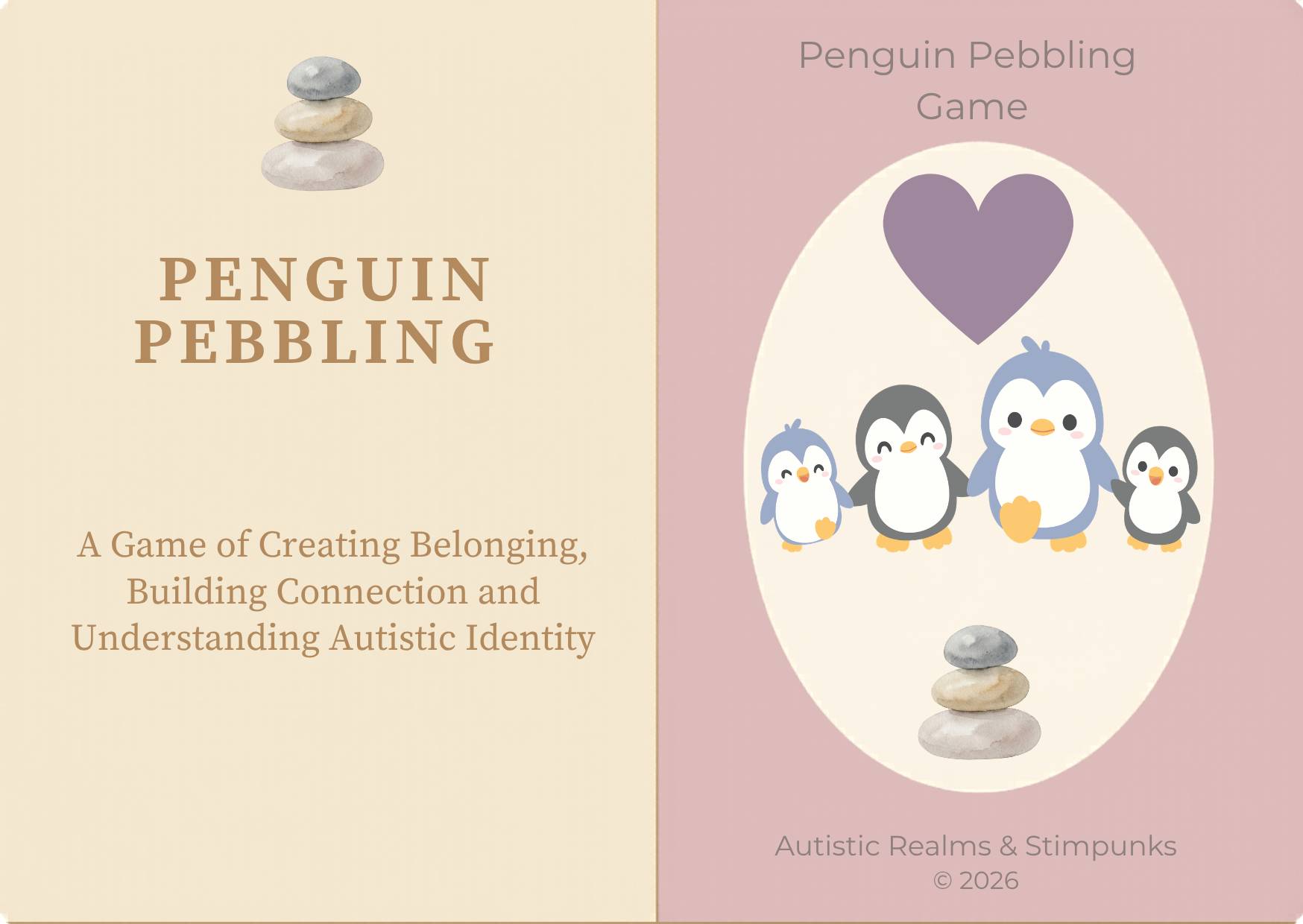
  • Penguin Pebbling: An Autistic Love Language

    Penguin Pebbling: An Autistic Love Language

    Penguin Pebbling is a neurodivergent way of showing you care, like sharing a meme or twig or pretty stone to say “I’m thinking of you,” inspired by penguins who gift pebbles to those they care about.


  • What Would A Neuroqueer Pedagogy Be?

    What Would A Neuroqueer Pedagogy Be?

    “What would a neuroqueer pedagogy be?” By Ombre Tarragnat (English translation with permission from Genre en Cours article Feb 2026)


  • Intensive Interaction as Neuro-Affirming Relational Practice

    Intensive Interaction as Neuro-Affirming Relational Practice

    Intensive Interaction isn’t about “fixing” or prompting communication. It’s about meeting someone where they are—through connection, attunement, and shared flow. A neuro-affirming, relational framing to support those with profound and multiple learning disabilities.


  • Weird Pride in a Hostile World

    Weird Pride in a Hostile World

    Weird Pride is a practice of becoming. A refusal to shrink. A quiet, feral devotion to staying alive as ourselves in a world that keeps trying to make us something else.


This website stores cookies on your computer. These cookies are used to provide a more personalized experience and to track your whereabouts around our website in compliance with the European General Data Protection Regulation. If you decide to to opt-out of any future tracking, a cookie will be setup in your browser to remember this choice for one year.

Accept or Deny

WordPress Cookie Plugin by Real Cookie Banner