Image of umbrella with text in orange and yellow boxes: Is it Neurodivergent Burnout or could it be PANS/PANDAS? Signs of both may include: Motor & sensory challenges & changes, Sudden/ increased OCD, Changes in mood/emotional regulation, Restricted eating/Changes to eating pattern, Sudden/ Increased repetitive behaviours Heightened anxiety, fears & panic, Exhaustion, Suddenly struggling in many activities & areas of life, including school & relationships, Language/ communication changes, Insomnia/sleep difficulties, PANS/PANDAS is a medical condition. If your neurodivergent child is experiencing PANS/PANDAS or/and in Burnout they will need support. They will need more rest, more time stimming, lower demands, and more time to engage in their passions to help recover. Key information: PANS/PANDAS follows illness, and have a sudden onset or escalation of struggles/symptoms. Seek medical advice. If you are a parent/carer or professional and suspect PANS/PANDAS, visit www.panspandasuk.org for information and support. Be curious. ......Explore before you conclude!

Could it be PANS/PANDAS… Be Curious!

This collection of text and images was created collaboratively by neurodivergent educators, working together to shine a light on this often-overlooked area of care and support.

Helen EdgarJoanne RiordanLaura HellfeldViv DawesJulie Webb and Ben Palmer .


Have you noticed a change in your child’s ability to cope with life or a decline in their well-being?

It is worth being curious about what may be going on.

If your child is neurodivergent and struggling, they may be experiencing neurodivergent burnout.

However, if the change was sudden or may have been following an illness, it is also worth considering and finding out about PANS/PANDAS, especially if there has been a sudden onset or escalation of multiple unexplained changes following an illness. There are many overlaps between the presentation of PANS/PANDAS and burnout.

PANS and PANDAS are medical conditions. People with PANS or PANDAS may experience a variety of symptoms impacting mental and physical health and also the sensory system. Please seek medical advice if you think your child has PANS/PANDAS.

For more information about Autistic and Neurodivergent Burnout see my resource page. For more information about PANS/PANDAS and Neurodivergence see PANS PANDAS Charity website information page:
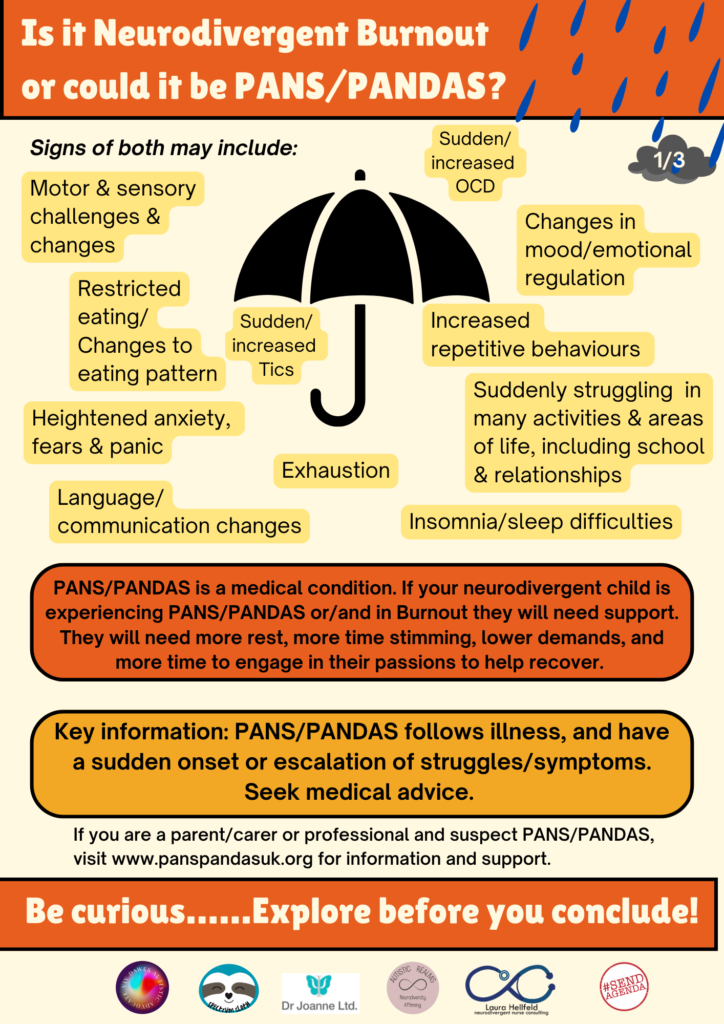
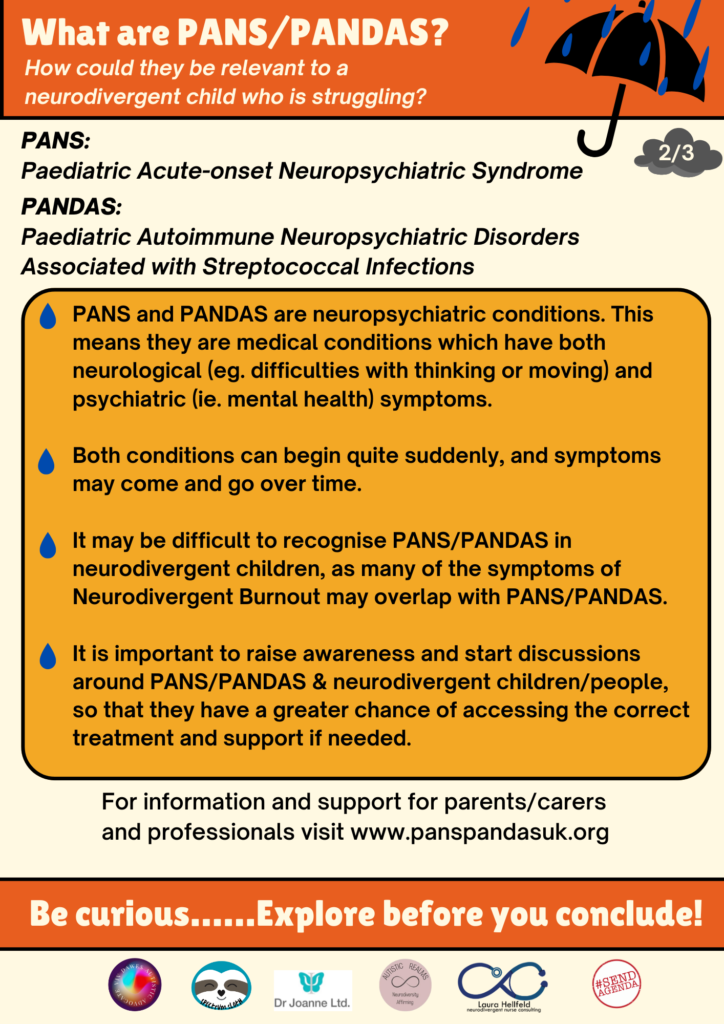
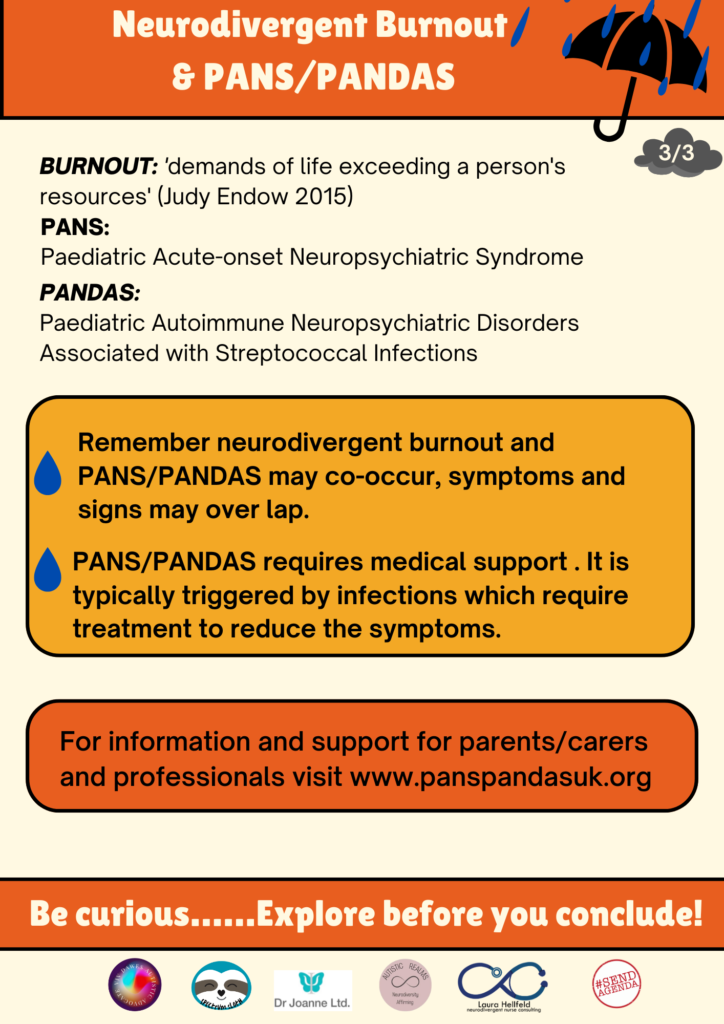
Image of umbrella with text in orange and yellow boxes: Is it Neurodivergent Burnout or could it be PANS/PANDAS? Signs of both may include: Motor & sensory challenges & changes, Sudden/ increased OCD, Changes in mood/emotional regulation,  Restricted eating/Changes to eating pattern,  Sudden/ Increased repetitive behaviours Heightened anxiety, fears & panic, Exhaustion, Suddenly struggling in many activities & areas of life, including school & relationships, Language/ communication changes, Insomnia/sleep difficulties, PANS/PANDAS is a medical condition. If your neurodivergent child is experiencing PANS/PANDAS or/and in Burnout they will need support. They will need more rest, more time stimming, lower demands, and more time to engage in their passions to help recover. Key information: PANS/PANDAS follows illness, and have a sudden onset or escalation of struggles/symptoms. Seek medical advice. If you are a parent/carer or professional and suspect PANS/PANDAS, visit www.panspandasuk.org for information and support. Be curious. ......Explore before you conclude!
Image of umbrella with text in orange and yellow boxes: What are PANS/ PANDAS? How could they be relevant to a neurodivergent child who is struggling? PANS: Paediatric Acute-onset Neuropsychiatric Syndrome PANDAS: Paediatric Autoimmune Neuropsychiatric Disorders Associated with Streptococcal Infections 13 PANS and PANDAS are neuropsychiatric conditions. This means they are medical conditions which have both neurological (eg. difficulties with thinking or moving) and psychiatric (ie. mental health) symptoms. Both conditions can begin quite suddenly, and symptoms may come and go over time. • It may be difficult to recognise PANS/PANDAS in neurodivergent children, as many of the symptoms of Neurodivergent Burnout may overlap with PANS/PANDAS. It is important to raise awareness and start discussions around PANS/PANDAS & neurodivergent children/people, so that they have a greater chance of accessing the correct treatment and support if needed. For information and support for parents/carers and professionals visit www.panspandasuk.org Be curious......Explore before you conclude!
Image of umbrella with text in orange and yellow boxes: Neurodivergent Burnout / & PANS/PANDAS 3/3 BURNOUT: 'demands of life exceeding a person's resources' (Judy Endow 2015) PANS: Paediatric Acute-onset Neuropsychiatric Syndrome PANDAS: Paediatric Autoimmune Neuropsychiatric Disorders Associated with Streptococcal Infections Remember neurodivergent burnout and PANS/PANDAS may co-occur, symptoms and signs may over lap. PANS/PANDAS requires medical support. It is typically triggered by infections which require treatment to reduce the symptoms. For information and support for parents/carers and professionals visit www.panspandasuk.org Be curious. ......Explore before you conclude!

Signposting and Resources

The following list was collated and shared by Romy Worthington and shared by Laura Hellfeld in their Substak blog


Find out more about Neurodivergence and PANS/PANDAS

Dr Tim Ubhi, Clinical Director at The London PANS Clinic & Children’s e-Hospital, is pleased to announce the launch of Plaito, a dedicated PANS/PANDAS AI specialist now available at e-hospital.co.uk.

Plaito has been trained on the questions and concerns most commonly raised by parents of children with PANS/PANDAS and by health professionals working in the field — making it a knowledgeable, accessible first point of support for the community.

Dr Ubhi and his team welcome everyone to ask Plaito anything related to PANS/PANDAS. Plaito will continue to develop and learn over time, and human oversight will be maintained on its responses to ensure quality and safety.

One of Plaito’s most exciting features is that it speaks all languages — a significant step toward bringing the global PANS/PANDAS community together for the very first time.

To access Plaito, simply go to the messages bubble in the top right of the screen, select Agents, and choose Plaito.



Latest Posts

  • Autistic Burnout – Supporting Young People At Home & School

    Autistic Burnout – Supporting Young People At Home & School

    Autistic burnout in young people is real—and recovery starts with understanding. This post offers neuroaffirming ways to spot the signs, reduce demands, and truly support. 💛 #AutisticBurnout #Neuroaffirming #Monotropism #AutisticSupport


  • Monotropic Interests and Looping Thoughts

    Monotropic Interests and Looping Thoughts

    The theory of monotropism was developed by Murray, Lawson and Lesser in their article, Attention, monotropism and the diagnostic criteria for autism (2005). ​ Monotropism is increasingly considered to be the underlying principle behind autism and is becoming more widely recognised, especially within autistic and neurodivergent communities. Fergus Murray, in their article Me and Monotropism:…


  • Map of Monotropic Experiences

    Map of Monotropic Experiences

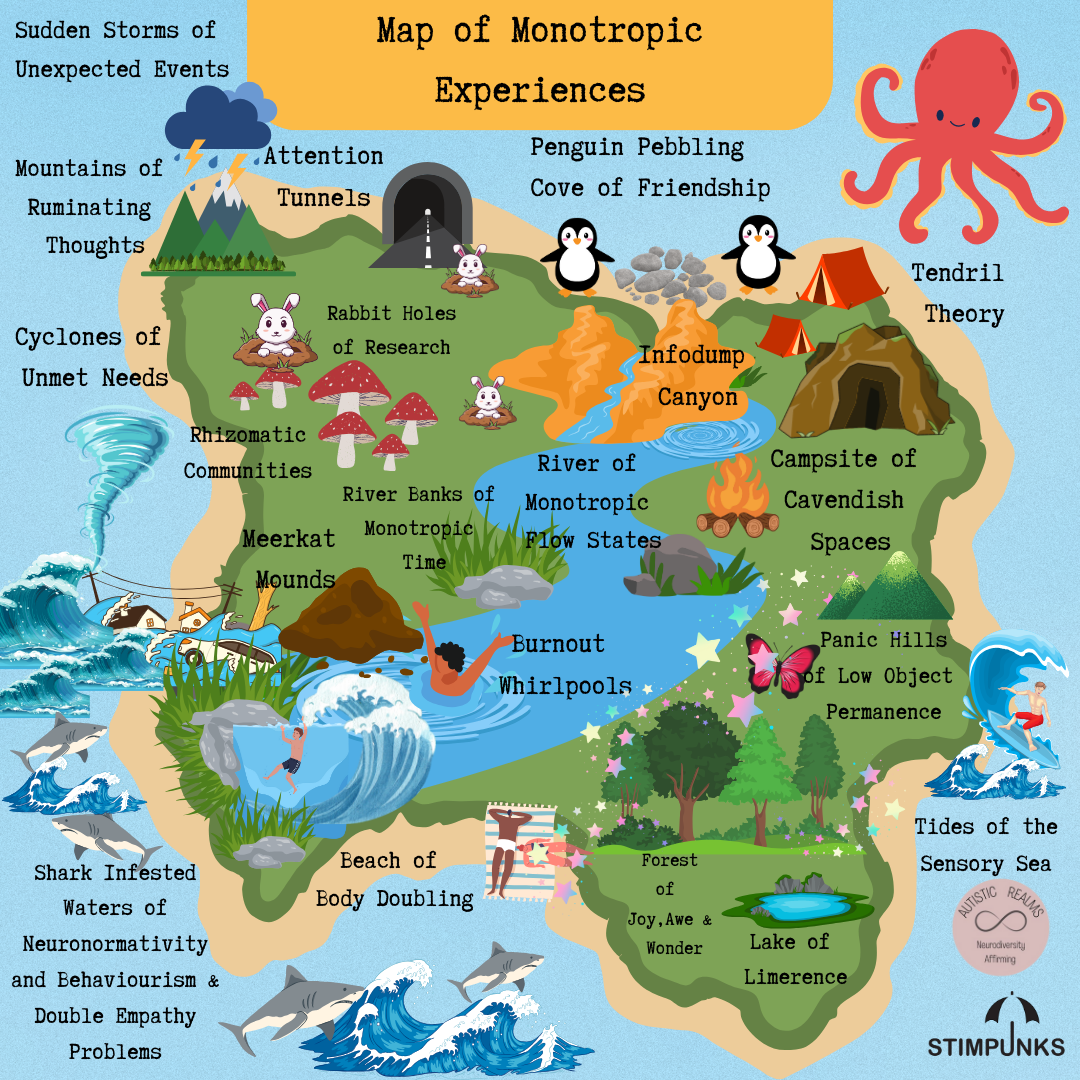
    Monotropism seeks to explain Autism in terms of attention distribution and interests.  OSF Preprints | Development and Validation of a Novel Self-Report Measure of Monotropism in Autistic and Non-Autistic People: The Monotropism Questionnaire This map highlights 20 common aspects of my personal monotropic experiences. How many do you experience? Where are you on the map…


  • Autistic Burnout – Supporting Young People At Home & School

    Autistic Burnout – Supporting Young People At Home & School

    Being autistic is not an illness or a disorder in itself, but being autistic can have an impact on a person’s mental and physical health. This is due to the often unmet needs of living in a world that is generally designed for the well-being of people who are not autistic. In addition, three-quarters of…


  • The Double Empathy Problem is DEEP

    The Double Empathy Problem is DEEP

    “The growing cracks in the thin veneer of our “civilised” economic and social operating model are impossible to ignore”, Jorn Bettin (2021). The double empathy problem (Milton, 2012) creates a gap of disconnect experienced between people due to misunderstood shared lived experiences. It is “a breakdown in reciprocity and mutual understanding that can happen between people…


  • Top 5 Neurodivergent-Informed Strategies

    Top 5 Neurodivergent-Informed Strategies

    Top 5 Neurodivergent-Informed Strategies By Helen Edgar, Autistic Realms, June 2024. 1. Be Kind Take time to listen and be with people in meaningful ways to help bridge the Double Empathy Problem (Milton, 2012). Be embodied and listen not only to people’s words but also to their bodies and sensory systems. Be responsive to people’s…


  • Autistic Community: Connections and Becoming

    Autistic Community: Connections and Becoming

    Everyone seeks connection in some way or another. Connections may look different for autistic people. In line with the motto from Anna Freud’s National Autism Trainer Programme (Acceptance, Belonging and Connection), creating a sense of acceptance and belonging is likely to be more meaningful for autistic people than putting pressure on them to try and…


  • Monotropism, Autism & OCD

    Monotropism, Autism & OCD

    Exploring similarities and differences between Autistic and OCD monotropic flow states. Can attention tunnels freeze, and thoughts get stuck?


  • Monotropism Questionnaire & Inner Autistic/ADHD Experiences

    Monotropism Questionnaire & Inner Autistic/ADHD Experiences

     Post first published 28th July 2023 Over the past few weeks, there has been a sudden surge of interest in the Monotropism Questionnaire (MQ), pre-print released in June 2023 in the research paper ‘Development and Validation of a Novel Self-Report Measure of Monotropism in Autistic and Non-Autistic People: The Monotropism Questionnaire.‘ by Garau, V., Murray,…


  • Penguin Pebbling: An Autistic Love Language

    Penguin Pebbling: An Autistic Love Language

    Penguin Pebbling is a neurodivergent way of showing you care, like sharing a meme or twig or pretty stone to say “I’m thinking of you,” inspired by penguins who gift pebbles to those they care about.


  • Between Being and Belonging

    Between Being and Belonging: An ecological game about neurodivergent thriving, exploring the webs that hold us within our ecosystems, and what can grow from the spaces between us This is in beta mode – a collaborative project between myself, Helen Edgar (Autistic Realms) with David Gray-Hammond at Neurohub Community. (with may be support from Ryan…


  • Resending: 🐧 Introducing the Penguin Pebbling Game

    Resending: 🐧 Introducing the Penguin Pebbling Game

    Autistic RealmsHelen Edgar Autistic Advocate, Author & ConsultantNeurodiversity-Affirming Supporting Autistic People To Grow & Thrive Welcome to Autistic Realms Newsletter! Introducing: Penguin Pebbling: A Game of Creating Belonging, Building Connection and Understanding Autistic Identity Something new has just landed at Autistic Realms, and it has been made with a lot of love in collaboration with…


  • 🐧 Introducing the Penguin Pebbling Game

    🐧 Introducing the Penguin Pebbling Game

    Autistic RealmsHelen Edgar Autistic Advocate, Author & ConsultantNeurodiversity-Affirming Supporting Autistic People To Grow & Thrive Welcome to Autistic Realms Newsletter! Introducing: Penguin Pebbling: A Game of Creating Belonging, Building Connection and Understanding Autistic Identity Something new has just landed at Autistic Realms, and it has been made with a lot of love in collaboration with…


This website stores cookies on your computer. These cookies are used to provide a more personalized experience and to track your whereabouts around our website in compliance with the European General Data Protection Regulation. If you decide to to opt-out of any future tracking, a cookie will be setup in your browser to remember this choice for one year.

Accept or Deny

WordPress Cookie Plugin by Real Cookie Banner