Child sat on floor with head in hands

Autistic Burnout – Supporting Young People At Home & School

In addition, three-quarters of autistic children also have other types of neurodivergence (Lang et al. 2024); this can make life even more difficult for those people. The difficulties young autistic and other multiple neurodivergent people are experiencing are reflected in the devastating current UK school attendance data. The research from Connolly et al. (2023) showed that ‘92.1% of those with school attendance difficulties are neurodivergent. 83.4% are autistic’.  The  Not Fine in School: Family Support for School Attendance Difficulties FaceBook group currently has a staggering and upsetting figure of over 51K members. 

School Attendance

January 2024 began with a new poster campaign from the Department for Education to tackle attendance issues. Unfortunately this is potentially going to be at a huge cost to children’s physical and mental health unless people have a better understanding of neurodivergent children’s needs and adopt a trauma informed approach. According to data gathered by The Guardian (Weale, 09/01/2024), more than a fifth (21.2%) of pupils in England are what is described as being ‘persistently absent’  (missing 10% or more school sessions) across the autumn and spring terms 2022-23.  There is not any data to know how many of these young people may be experiencing autistic burnout, however, I would imagine it would likely be a high proportion. 

Children do well when and if they can,  (Greene, 2008). No child wants to miss out on friendships and learning opportunitie s and experience mental health difficulties. Research by O’Halloran (2022) showed 25% of autistic youth experienced suicidal ideation. School attendance at all costs is dangerous. We need to  be aware of  and understanding the implications to mental and physical health of unmet mends that is causing long term trauma and costing lives.  It is not as easy as ‘just’ getting children into school by either rewards or sanctions. If it were that simple, we would not have such a problem.


Text reads_ Autistic Burnout Possible Signs for children, Changes to usual mood, Heightened anxiety, Difficulties with executive functioning, Changes to sleep and eating patterns

Latest Posts

  • Autistic Burnout – Supporting Young People At Home & School

    Autistic Burnout – Supporting Young People At Home & School

    Autistic burnout in young people is real—and recovery starts with understanding. This post offers neuroaffirming ways to spot the signs, reduce demands, and truly support. 💛 #AutisticBurnout #Neuroaffirming #Monotropism #AutisticSupport


  • Monotropic Interests and Looping Thoughts

    Monotropic Interests and Looping Thoughts

    The theory of monotropism was developed by Murray, Lawson and Lesser in their article, Attention, monotropism and the diagnostic criteria for autism (2005). ​ Monotropism is increasingly considered to be the underlying principle behind autism and is becoming more widely recognised, especially within autistic and neurodivergent communities. Fergus Murray, in their article Me and Monotropism:…


  • Map of Monotropic Experiences

    Map of Monotropic Experiences

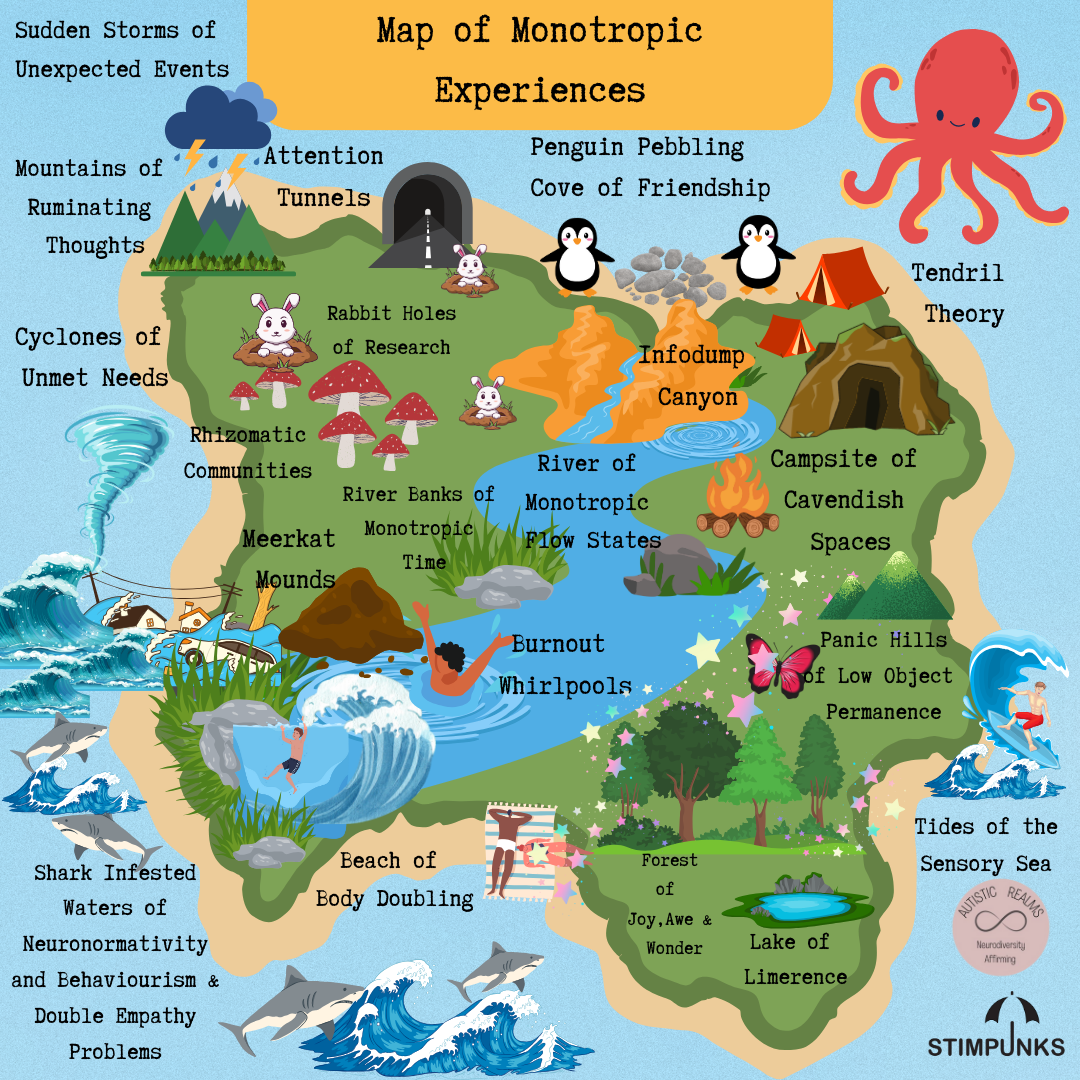
    Monotropism seeks to explain Autism in terms of attention distribution and interests.  OSF Preprints | Development and Validation of a Novel Self-Report Measure of Monotropism in Autistic and Non-Autistic People: The Monotropism Questionnaire This map highlights 20 common aspects of my personal monotropic experiences. How many do you experience? Where are you on the map…


  • Autistic Burnout – Supporting Young People At Home & School

    Autistic Burnout – Supporting Young People At Home & School

    Being autistic is not an illness or a disorder in itself, but being autistic can have an impact on a person’s mental and physical health. This is due to the often unmet needs of living in a world that is generally designed for the well-being of people who are not autistic. In addition, three-quarters of…


  • The Double Empathy Problem is DEEP

    The Double Empathy Problem is DEEP

    “The growing cracks in the thin veneer of our “civilised” economic and social operating model are impossible to ignore”, Jorn Bettin (2021). The double empathy problem (Milton, 2012) creates a gap of disconnect experienced between people due to misunderstood shared lived experiences. It is “a breakdown in reciprocity and mutual understanding that can happen between people…


  • Top 5 Neurodivergent-Informed Strategies

    Top 5 Neurodivergent-Informed Strategies

    Top 5 Neurodivergent-Informed Strategies By Helen Edgar, Autistic Realms, June 2024. 1. Be Kind Take time to listen and be with people in meaningful ways to help bridge the Double Empathy Problem (Milton, 2012). Be embodied and listen not only to people’s words but also to their bodies and sensory systems. Be responsive to people’s…


  • Autistic Community: Connections and Becoming

    Autistic Community: Connections and Becoming

    Everyone seeks connection in some way or another. Connections may look different for autistic people. In line with the motto from Anna Freud’s National Autism Trainer Programme (Acceptance, Belonging and Connection), creating a sense of acceptance and belonging is likely to be more meaningful for autistic people than putting pressure on them to try and…


  • Monotropism, Autism & OCD

    Monotropism, Autism & OCD

    This blog has been inspired by Dr Jeremy Shuman’s (PsyD) presentation, ‘Neurodiversity-Affirming OCD Care‘ (August 2023), available here. Exploring similarities and differences between Autistic and OCD monotropic flow states. Can attention tunnels freeze, and thoughts get stuck? Autism research is shifting; many people are moving away from the medical deficit model and seeing the value…


  • Monotropism Questionnaire & Inner Autistic/ADHD Experiences

    Monotropism Questionnaire & Inner Autistic/ADHD Experiences

     Post first published 28th July 2023 Over the past few weeks, there has been a sudden surge of interest in the Monotropism Questionnaire (MQ), pre-print released in June 2023 in the research paper ‘Development and Validation of a Novel Self-Report Measure of Monotropism in Autistic and Non-Autistic People: The Monotropism Questionnaire.‘ by Garau, V., Murray,…


  • Penguin Pebbling: An Autistic Love Language

    Penguin Pebbling: An Autistic Love Language

    Penguin Pebbling is a neurodivergent way of showing you care, like sharing a meme or twig or pretty stone to say “I’m thinking of you,” inspired by penguins who gift pebbles to those they care about.


  • New Book – Re-Storying Autism

    New Book – Re-Storying Autism

    Autistic RealmsHelen Edgar Autistic Advocate, Author & ConsultantNeurodiversity-Affirming Supporting Autistic People To Grow & Thrive Welcome to Autistic Realms Newsletter! The days are counting down to the release of mine and David Gray-Hammond’s new workbook to support our upcoming on-demand training course: Re-Storying Autism – A Framework For Families, Parents, And Carers: Reimagining Support For…


  • Stimming as Embodied Sensory Language

    Stimming as Embodied Sensory Language

    Reframing stimming beyond “behaviour” as embodied sensory language, monotropic flow, and neuroqueer, interdependent connection with the world.


  • Embracing Our Autistic Selves Course

    Embracing Our Autistic Selves Course

    Autistic RealmsHelen Edgar Autistic Advocate, Author & ConsultantNeurodiversity-Affirming Supporting Autistic People To Grow & Thrive Welcome to Autistic Realms Newsletter! Happy New Year! I am delighted to be facilitating a new course ‘Embracing our Autistic Selves’ delivered by David Gray-Hammond starting Jan 7th 2026. Embracing Our Autistic Selves is a three-week online experience (via Zoom)…


WordPress Cookie Plugin by Real Cookie Banner